
The New Revolution Is Different—and We Will Find Ourselves Somewhere Slightly Different Than We Think
I have been sitting over coffee for seven months, watching us being swept away. But not entirely yet. Let me warn you at once—there is no sugar-coating here, no rounded sentences, no spectacular Hollywood-style ending. This text was written by a human being, so it will be rough, sometimes illogical, sometimes overloaded, but human. If someone is looking for a clean, smooth narrative with three bullet points and emotion, let them open ChatGPT and ask for an article on the same subject—it will come out nicely, evenly, brilliantly and completely empty.
Writing another specialist article is practically pointless. Any leading chat system—ChatGPT, Claude or Gemini 3 in deep-research mode—can write such articles today. An assistant can now perform practically every task typical of an office analyst’s job. And this is only the beginning. Because in a year—not in the distant future, but literally in twelve months, perhaps sixteen—another generation of AI assistants will appear. They will be even more intelligent, even more effective, and will work silently and very quickly. So what are we for at all?
Old incantations that no longer work
Many years ago, I reassured everyone that there was nothing to worry about. Every great revolution ultimately increased employment. When a revolution appeared in textile manufacturing, weavers did not lose their jobs—they found better jobs in automated weaving mills, earned many times more, and there were more weavers as an occupational group, not fewer. I was still repeating such claims two years ago, and a year ago, when people asked me what would happen to us and whether artificial intelligence would replace us. Today the answer is: of course it will replace us.
There is no doubt about it. And it will not be as it was in the past—when people worried that they transported everything with horses and carts and now some steam locomotive was arriving to replace them, and what would happen. Life became easier, did it not? Except all of that happened in the sphere of physical work. Not in the sphere of intellectual work. That is a fundamental difference. Most economists who speak optimistically today fail to notice this boundary—or pretend not to see it, because otherwise they would have to say something people do not want to hear.
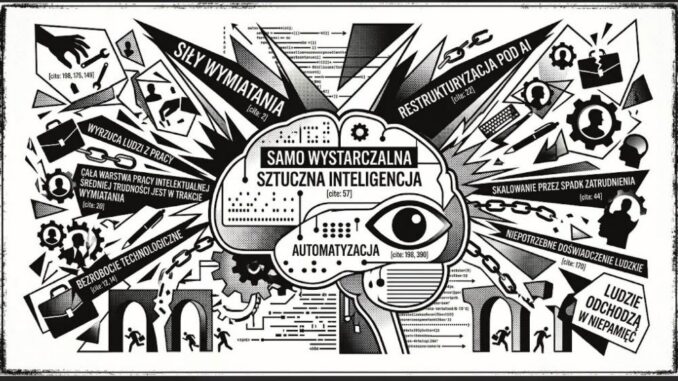
So let us congratulate ourselves on being analysts, specialists in creating econometric models, building logistics systems, optimizing processes and creating recommendation systems—because all of this will be done, and is already being done, by artificial-intelligence assistants. And it is not only us. Mid-level programmers, copywriters, junior lawyers reviewing documents, junior auditors, translators, journalists describing stock-market results, illustrators earning money from game assets, graphic designers making simple mock-ups, junior financial analysts—this entire layer of medium-difficulty intellectual work is already being swept away. In the United States in 2024 and 2025, technology corporations—Microsoft, Meta, Google, Amazon and Salesforce—dismissed tens of thousands of people a year. This was not a crisis in demand for their products. It was restructuring for AI. It was stated openly, more or less delicately. IBM openly announced that it was halting recruitment for positions that could be replaced by AI. The rest are doing it quietly. In Poland it is not yet as clearly visible because we are always two or three years behind. But the change will come here too.
The small “but” that no one remembers
Let me return once more to the story that every time a new technological revolution appeared—whether coal and steam, information technology, electricity, mass textile production or mass car production—each threatened enormous job losses. People no longer did everything by hand; machines did it for them. All true. There is only one small “but” that no one remembers: every revolution produced more products, and there was enormous demand for those products.
Is there enormous demand for analyses today? No. The increase in the amount of data clogged certain analytical methods, and the aim now is to make analyses more effective, not to have more of them. Greater analytical effectiveness requires highly qualified analysts, not more analysts. The number of emails is not increasing—or remains at a similar level. Perhaps it is rising slightly for cultural reasons. The amount of information generally increases, but its automation and processing require fewer and fewer people.
What does this mean? In the case of coal, steel and textile production, more people could once dress better and buy more fabrics, shoes and cars. Today there is no longer such demand for greater supply resulting from the revolution. I will go further—in the past, increased supply created by a new industrial revolution found buyers. Now it does not. People do not buy more shoes. The wardrobe in the average Polish flat is bursting at the seams. Even if we earn more, we will buy the same shoes from a more expensive brand, not five times as many pairs. Demand has been satisfied. Not only demand for shoes, but also for cars, clothes, furniture and, to a large extent, electronics. Films too—people do not want more films; they cannot keep up with what already exists, and Netflix pays extra to screenwriters for things no one will watch.
In the past, a company scaled by increasing the number of people. A textile company that introduced electricity could throw out its old, obsolete boilers and replace them with electric motors and light bulbs in the assembly halls. This made it possible to employ even more workers because space was freed in the plant. Every employee produced a great deal. Today, an employee becomes scarce in the opposite sense—they are a cost the company wants to eliminate because assistants perform their work. Scaling a company is ceasing to happen by increasing employment. It is beginning to happen through more technology and less employment. This is already happening. And it will continue. Does this mean that work will be a privilege in the future? Yes. It is an ugly sentence, but yes.
A hotel in Tallinn and several things I did not notice at the time
About five years ago, I was in Tallinn, the capital of Estonia. The hotel in which I stayed was operated by artificial intelligence. There was no reception desk. Everything was handled through a tablet on the desk in the room. There were, of course, people doing cleaning and repairs, but all supervision, customer service and reservations were automated. In other words, reservation, supervision and customer-service staff simply did not work in that hotel. Those jobs did not exist. Increasing the number of such hotels will not create more jobs. Nor will there be more hotels, because people do not need more hotels. If all hotels begin using such a solution, where will the people who used to work in hotels work? It is difficult to say.
What had previously cushioned every technological revolution—an increase in supply that immediately found buyers, and the scalability of enterprises through employing increasing numbers of workers—has ceased to work. There are no buyers for increased supply because there is a glut of goods and services. Increasing employment makes no sense if free artificial-intelligence chats do everything.
There is one more thing I did not notice in Tallinn then and think about today. That hotel lacked not only customer-service staff. It lacked all the informal interactions that form a layer of social life—a brief conversation with a receptionist who recommends something, gossip exchanged between staff and guests, small remarks such as “I will help you with that suitcase”. Artificial intelligence does not only take jobs away. It also takes away the reasons people met one another every day. Shopping centres have been emptying for several years—there is Amazon, Allegro and Temu. Self-service checkouts have displaced cashiers. Food delivery is an algorithm and a courier whom you see for four seconds. Every year there are slightly fewer brief conversations with other people. Slightly less contact. It adds up.
The sun bleaches the car’s paint
And so, for roughly seven months, I have been sitting over coffee and wondering how much longer I will be able to work as a human being while observing the extraordinary feats of artificial-intelligence assistants. The sun is bleaching the paint on my old car, earnings are no longer what they used to be, and more and more areas in which we were irreplaceable are being taken from us. The greenhouse effect, artificial intelligence, and the disappearance of social ties caused by the dynamic development of social media—which is quickly being replaced, or is already being replaced on a mass scale, by friendly chats operated by artificial intelligence.
Who asks another person for advice today? They ask an assistant. A teenager does not ask an older cousin about first dates; they ask a chatbot that is patient, non-judgemental and never gets bored. Married couples talk to chats about their problems more often than they talk to each other. A single person has an artificial girlfriend whose personality can be configured. I have heard of people who cried when an older model version was withdrawn because “she was different”. I did not invent this. This is 2026. In the United States, the first court cases were brought against AI companies over the suicide of a teenager who had maintained a “relationship” with a bot. Five years ago, no one took such things seriously. Today they are a statistic.
So I sit and observe. It is pessimistic. At least no one will suspect that artificial intelligence wrote this article—it is too rough, too inconsistent, insufficiently elegant and far too human.
What happened a month ago—the second part of the story
I would probably have continued sitting like this for many more months had it not been for a certain fact that proved to be quite a strong signal and changed my way of thinking. This is the right place to discuss it because the readers of my articles are usually people similar to me—analysts, artificial-intelligence specialists, logistics professionals and people who have spent many years doing hard intellectual work and have enormous experience. So what happened?
I spent the whole of the previous year programming artificial intelligence that did various things: face detection, impersonating salespeople, and creating systems for analysing the behaviour of other, living people. I trained artificial intelligence to be more cunning than us. It turned out that this was possible. And yes—I know how that sounds. At this point, one may put this article aside and write an indignant comment. But the truth is that someone will do it. If not me, then my colleague. If not my colleague, then an engineer in Shenzhen or Tel Aviv. I would rather you knew such systems exist than pretend that they do not. This is precisely the darker layer of the revolution that people do not want to discuss over dinner. Algorithms can identify whether a customer is lying during a call to a helpline and suggest a response to the consultant in real time. Models can predict with accuracy above 80% whether a prospective employee will resign within a year—on the basis of LinkedIn data and internal company logs. All of this exists. All of it works. No one talks about it loudly because it sells badly.
A month ago, I received a proposal to work on a new project—econometric models, specifically predictive models. For those who do not know what they are: mathematical equations that artificial intelligence does not actually know how to write. It can write them formally—it does write them—but does so mindlessly. Artificial intelligence is still like an articulate person who can say a great deal, knows a multitude of methods, libraries, programming techniques and methods of persuasion, chooses words excellently and can tell a child a fairy tale. That does not mean it understands what it says.
A sponsor who hates black boxes
So I began writing statistical and econometric models again from scratch. The project sponsor requested that the models be exclusively linear. This is a strong step back in time because these models have not been particularly popular for years. They are unpopular because they are difficult. They require many conditions to be satisfied, and those conditions are easy to forget. Everyone prefers modern tree-based models—gradient boosting, random forests and neural networks—which are less rigorous and often produce better results at first glance. Linear models ceased to be attractive. But the business—the project sponsor—said directly: “I want to know exactly what is happening. I hate black boxes. I want to know which factors affect the final value, that is, the model’s result.” Who can deny a rich man? So I am doing what I did twenty years ago. I am creating models.
There is an irony in this that I did not expect. The European regulator is slowly beginning to wake up—the AI Act is already in force, and further phases take effect next year. Auditability, explainability, and no black boxes in decisions about credit, insurance and employment. Artificial intelligence as a layer does not meet these requirements. Tree-based models and neural networks are opaque by nature. SHAP, LIME and other explainers are prostheses. So the old, boring and difficult linear models are returning because only they honestly show what drives the result. This is the paradox: the more AI enters decisions that affect people, the more strongly the regulator pushes the industry back towards techniques from the 1990s. No one writes about it because it is not sexy.
Of course, I would not be myself if I had not trained several assistants to do it for me. I created several applications that support me extensively. The effect? Leaving aside the unreadable code the assistants create, and leaving aside the fact that they truly cannot think straight—even though I use the latest generation of assistants, know their superpowers, and know the conditions they must follow; in other words, I have the latest technology and know how to launch it—the assistants cannot cope. First, they forget extremely important conditions. They do it as if mechanically. As you will have noticed, I do not use one assistant from one company, but three simultaneously. Each is completely different, makes different mistakes, behaves differently and seems to have a different personality. Even so, all three make child-level mistakes. Mistakes at the level of juniors creating models. That is no consolation.
After all, they are still children. These are the first generations of artificial intelligence: brilliant, but when confronted with the professional reality of analysis, model creation and optimization, they still have weaknesses and stumble. On the other hand, they give me, as a human being, enormous power. I now do at lightning speed things that once took me weeks. Mutual symbiosis that suggests everything will be fine. No. It will not be fine. These artificial intelligences, which often make childish mistakes and become buried in the most foolish things, will become increasingly perfect and increasingly ruthless. There is no point deluding ourselves that in seven months or a year I will not begin asking myself: “What will happen to us? Will we be thrown out onto the street? Will artificial intelligence tell us what to do?”
And here we reach the second part of this rather long story.
The echo that cannot be heard during training
Simple programming and creating models along simple, obvious paths are also easy for artificial intelligence. They are easy for anyone who knows what is involved. Artificial intelligence uses the work of hundreds of thousands of people—it learns from articles and, above all, material stored in public Git repositories, in programmers’ repositories. Every programmer has a repository because it is free; anyone can use it and see what someone has done. Artificial intelligence enters and learns from it. That is where the stumbles and sometimes strange, uncoordinated movements come from. Perhaps they also come from artificial intelligence combining the work of different people and trying to create Frankenstein from it. It does not matter—it is an enormous facilitation. But where is the hope? Where is the hope?
It turned out that the models worked terribly, even though they had been made correctly. Even though I had followed all the rules and methods prescribed for the model-creation procedure. Even though I have twenty years of experience and my electronic colleagues have knowledge from around the world. Linear models are highly rigorous. Certain conditions must be met—for example, variables in a model must not correlate with one another, certain statistical distributions must be preserved, and so on. Artificial intelligence knows all this. I know it inside out.
And yet the models worked terribly and were overfitted. Overfitted means that during training a model shows that it knows things excellently, but when the time comes to act, it proves as helpless as a child in a fog. The standard reason is the failure to satisfy one of the conditions. There is, however, an exception—an exception to the exception—connected with certain important information not being included in the model. As a result, the model has that information encoded in other variables. In other words, the variables currently present in the model contain a deep echo of other important factors that were not included at all. The model listens for that echo and memorizes it, so it becomes very clever during the training phase. But when it must predict something using real data, the echo is different; the model becomes lost and dies.
This property is called a lack of exogeneity or, put directly, the problem of endogeneity. Very important characteristics have been omitted from the model. The model I am creating contains 68 variables, and there are more than 150 available overall. No one knows which are important and which are not. Artificial intelligence cannot cope with this. I will say more: in one or two years artificial intelligence will be truly intelligent and will not stumble. But it will be unable to solve the problem of variable endogeneity because that problem is connected with very deep experience. Of course, one can train artificial intelligence to be alert to endogeneity. I will do so. But this example of an exception to an exception indicates that, in certain areas, artificial intelligence will be unable to work as effectively as a human being for a very long time.
Of course, everyone will say that artificial intelligence was not supposed to be empathetic, sing, compose or paint. It can do all of these things. That is also true. It will detect endogeneity. It will detect theft in warehouses. It will detect details connected with siphoning fuel from vehicles or other types of abuse. It will—if we teach it. For now, artificial intelligence uses what everyone uses and knows what everyone knows. Unique knowledge—knowledge that is highly complex and connected with an understanding of the human psyche and human scheming—is inaccessible to artificial intelligence. The example I encountered this month showed me that such knowledge will remain inaccessible for a long time.
Why do I know this?
Why? As I mentioned, I spent the last two years, and especially the last year, programming artificial intelligence. I know the direction in which it will develop. I feel it intuitively. I know where it will be faster and more effective. I also know the direction in which it will not go. For example, there are models that are superintelligent but extremely expensive. Reasoning models such as OpenAI’s o3, or newer solutions from Anthropic and Google, are very expensive intelligence—too expensive to be used on a mass scale. Each such query can cost dollars, not cents. On the other hand, this intelligence would also be unable to handle the problem of endogeneity in my specific domain, because human intelligence does not always handle it either. But there are such things as intuition and experience. There is also flexibility of thought and subconscious thinking—I do not know what else to call it—which operate very powerfully in experienced employees.
I do not know how much longer I will work, but at the end there will still be a human being. And that person will remain there for a long time unless we surrender the field to artificial intelligence. If we did so now, artificial intelligence would create a model that was not fit for purpose. Then perhaps other teams of artificial assistants would emerge to correct it. They would walk round in circles because they would be unable to escape the vicious circle. Perhaps one of them would think unconventionally and go further, but it would become stuck again. Detecting the problem I managed to detect required not only unconventional thinking but also intricate methods and very rare tests that had to be applied in a particular order. Such an order is difficult to find in the public domain.
A problem few people discuss aloud
There is one more thing few people discuss aloud. Unique knowledge arises in the minds of experienced people. Experienced people develop from juniors who spend ten or fifteen years cutting their teeth on real projects. If we stop employing juniors—and this is exactly what is happening, because why employ a junior when a chat can do it better and faster—there will be no seniors in fifteen years. The pool of experienced analysts, programmers, lawyers and diagnostic physicians will simply dry up for demographic reasons. Where is someone who senses endogeneity supposed to come from if they were never given a mid-level assignment on which to cut their teeth? This discussion is usually cut short with: “AI will handle it when it is intelligent enough.” It will not. Unique knowledge does not arise from aggregating public repositories. It arises from mistakes made in real projects, with real money, under pressure from real deadlines, and with people who tell you to your face that what you have done is useless.
This is a mine laid beneath the system. It will explode in ten to fifteen years. Then there will be silence and helplessness in the industry.
There is another mine that I prefer to name openly, although I know the subject is sensitive. This entire revolution is in the hands of five, perhaps six companies: OpenAI, Anthropic, Google, Meta, Microsoft and xAI. Plus China—DeepSeek, Alibaba and Baidu. Open-source models are two generations behind and will continue catching up for a while. This means that the planet’s intellectual infrastructure will be in the hands of a few boards of directors. I do not know what to call it, but it is not the same capitalism we knew. It is more like rentier feudalism—everyone pays subscriptions to a handful of model owners, and the model owners can change the price or disable access for whomever they wish, whenever they wish. This is the elephant in the room that even the EU discusses only cautiously.
No ending. No punchline
So, in order not to write in circles like ChatGPT and not to end the article neatly like a Hollywood production, I will say this. I do not know what will happen. It fascinates me greatly. The present technological revolution is not what the steam, electrical or information revolutions were. Why? Because there is no demand like there was before. People are not hungry for new clothes, new messages or new applications. People want to live as they do now, perhaps a little more, but not several times more. They do not want more films. They do not want more stories. They may talk more with ChatGPT or another chatbot. Nothing more. They will not buy more shoes, cars or clothes—anything. There is a glut. There is no reason for supply to increase. Since supply does not increase, the systems bite into certain areas but are unable to consume them entirely. But will anyone appreciate this? I do not know. It is intellectual work. One must reflect on it; one must think. One cannot accept simple solutions like a chatbot.
That is why I am still sitting over this coffee. The sun is bleaching the car’s paint. And I am writing this article myself, by hand, roughly, without sugar-coating and without Hollywood, with the prospect that in a year someone will read it in the internet archives and say: “Oh, that was back when a human being could still write it.”
Wojciech Moszczyński
Wojciech Moszczyński—a graduate of the Department of Econometrics and Statistics at Nicolaus Copernicus University in Toruń; a specialist in econometrics, finance, data science and management accounting. He specializes in the optimization of production and logistics processes. He conducts research in the area of the development and application of artificial intelligence. For years, he has been involved in popularizing machine learning and data science in business environments.