
August 2009 | Przegląd Piekarski i Cukierniczy (Baking and Confectionery Review)
An analysis of the problem using the example of a bakery
Having too extensive a product range may be a great burden for a company. It is worth asking oneself the question whether a broad offer is an expression of high organisational ability or rather an example of unrestrained growth without any specific plan.
The decision concerning the choice of a development strategy is the basic factor in a bakery’s future success. The basic principle of strategy is the concentration of all the resources one possesses on the realisation of defined goals.
Effective development and the assurance of high quality of goods and services are possible when the company concentrates its efforts on this, and it is easier to concentrate on a short list of products. A large offer of products disperses that attention.
A bakery which has its own company shops has to fill them with something. It is commonly known that the customer buys with their eyes; although they want to buy the basic product – bread or rolls – they require the shop to display abundance. Without a broad product range a company shop loses its attractiveness, and customers begin to buy elsewhere. That is why, alongside the basic range (in the form of the most frequently bought bread and rolls), an additional range must appear (in the form of occasionally bought rolls and regional, decorative or health breads).
W-MOSZCZYNSKI ppic 8-09Because the additional range sells poorly, and manufacturing it is usually connected with higher unit costs than in the case of the basic products, the bakery incurs considerable losses on account of returns. The additional range is a necessary element of company shops; one should, however, strive to minimise the costs connected with it. An extensive product range is a great burden for the whole organisation, beginning with the orders department, production and order-picking, and ending with transport and settlements.
Why is a broad product range not good for a bakery?
A broad range of products testifies to a bakery’s great involvement in the market; it also testifies to great capabilities in the area of diverse manufacturing technologies. However, behind great diversity there lie high labour-intensiveness and organisational fragmentation.
The most important burdens.
- A long list of sales positions, called index items, is troublesome for the creation and execution of production orders. The introduction of quantitative orders containing a large number of index items, and likewise the monitoring of their execution, requires time and additional outlays of work.
- Fragmented production gives smaller possibilities of achieving the benefit resulting from a large scale of production; because of the fragmentation of production, part of the additional range is produced at a loss.
- Controlling production which is dispersed across the range is possible only through the introduction of specialised software and of discipline in observing appropriate procedures serving that purpose alone. The application of such measures will make it possible to control the volume of sales. Checking the profitability of individual products is a difficult task even for an experienced accountant, especially when the company applies differentiated discounts and returns from third-party shops.
- A large product range means many recipes, and it also means a decline in specialisation. Bakers are not able to bring all the products to perfection. Specialisation in a product range requires time, and a great range is connected with high labour-intensiveness.
- Bakeries usually send a large part of their additional ranges to third-party shops. The great fragmentation of delivery points together with a great product range causes a great burden on the bakery’s logistics system. In order to ensure the completeness of deliveries and their consistency with the orders as regards the time and the quantities ordered, the bakery is forced to expand its organisation in the non-production areas.
- A large number of goods is also connected with a longer stay by the drivers at the place of delivery. In order to ensure the punctuality of deliveries in the morning hours, along with the expansion of the product range it is indispensable to increase the transport potential by enlarging the fleet of vehicles.
- A great number of index items (a broader range) causes an additional difficulty when loading the bread into the baskets. An increase in the range is connected with an increase in the labour-intensiveness of loading and with a longer time devoted to that process. This means the necessity of employing additional workers and of excluding the drivers from the activity of loading the bread.
Sometimes, in order to grow, one must first shrink
The extension of the product range is followed by the growth of the whole organisation: the number of non-production employees increases, a new IT system is introduced, new delivery vehicles appear – in a word, the company is developing. Is that a good thing? Is it developing in a good direction?
It is good when the growth of the non-production sphere grows in parallel with the growth of revenues, and best when it develops in parallel with the growth of profitability. Usually, however, the growth of the additional range is connected more with the expansion of the non-production sphere, and through this it has a negative influence on the bakery’s profits.
Of course, before taking a decision on reducing part of the range it is good to carry out meticulous calculations and computations. The analysis concerns a great number of index items at various prices depending on the discounts applied and on the returns policy. A meticulous statement of all the costs and benefits for a great number of range index items is an enormous task which does not guarantee the achievement of the goal. In this case common sense is more needed than hard analytical work.
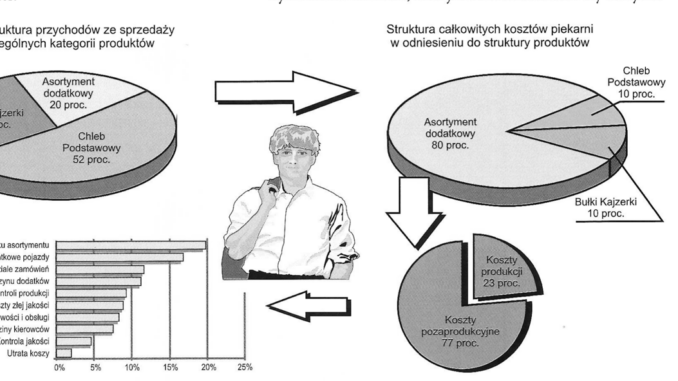
In almost every company possessing a sizeable product range, the structure of revenues takes the form of the so-called Pareto chart. This chart illustrates that 80 per cent of revenues is generated by 20 per cent of the range’s index items. In this case the 20 per cent of the range consists of the basic kinds of bread and rolls produced in large quantities, and the remaining 20 per cent of revenues comes from the great, fragmented additional range. This range is usually responsible for 80 per cent of the costs of non-production activity. The expansion of the bakery connected with the expansion of the offer therefore leads directly to a fall in its profitability. Carrying out a meticulous calculation may indicate differences in the structure of costs and revenues at the level of 5–10 per cent from the structure described above; it is therefore more sensible to trust Pareto.
The typical structure of revenues from the sale of the individual product categories: basic bread 52 per cent, additional range 20 per cent.
The structure of the bakery’s total costs in relation to the structure of products: basic bread 10 per cent, kaiser rolls 10 per cent, additional range 80 per cent.
How to shrink without throwing the baby out with the bathwater?
In what way should the reduction of the product range be carried out so as to make use of all the benefits which follow from it while at the same time not losing what is good?
Step one. A large product range in the company shops has to be maintained; this is not, however, necessary in the village and neighbourhood shops supplied by the bakery. It is precisely there that the greatest source of the burdensomeness of a large range is to be found. Usually bakeries initially expand the offer in order to present themselves well in their own company shops. The sales representatives, however, eagerly pick up the new goods and offer them to the small shops. If one wishes to reduce the non-production costs significantly, one has to introduce the principle of not sending the additional range to third-party shops.
Step two. The reduction of the kinds of products in the offer may be begun by striking off the list those products which sell in very small quantities. Even when the range being eliminated belongs to the group of goods which attract customers to the shops, such an action usually pays off.
Step three. The basic range should be separated out; usually, in revenue and quantity categories, it constitutes in total 80 per cent of the volume of sales. The basic list of products should be verified as regards its interchangeability with the basic products. Every sale of substitute (interchangeable) products from the additional list means smaller sales from the list of basic ranges.
Step four. Part of the additional products are similar to one another as regards appearance and taste. The products from the additional list should be reviewed and reduced as regards their mutual substitutability.
Step five. The reduced list of additional products can now be verified as regards the possibility of commissioning some positions from third-party bakeries. The list can also be supplemented with third-party goods with an extended shelf life, such as short pastry biscuits or sweets.
In running a bakery one should be guided in the first place by the basic principles of management strategy.
A bakery is a particular kind of company, burdened with high social responsibility. Every organisational or quality oversight is widely commented on in the local community. The bakery must therefore be a perfect organisation, in which organisation and work discipline play a particular role. In managing a bakery one should be guided by the expectations of the end customers. People usually have, in relation to particular things, from 3 to 7 basic needs which decisively influence their satisfaction or dissatisfaction. In the case of a bakery the consumer requires:
- that fresh, good-quality basic bread should be available every day from the earliest morning hours,
- a good location of the company shops,
- high hygiene in the sale of the products.
The additional range is a significant, but not the most important, factor in customer satisfaction. In the approach represented by quality management systems it is assumed that concentrating efforts on goals other than the key quality factors is an obvious waste of forces and resources.
Reducing the additional burden connected with servicing a large offer of additional products will make it possible to focus attention better on what is most important – on the satisfaction of our customers.
Wojciech Moszczyński
Equit Consulting
Wojciech Moszczyński — graduate of the Department of Econometrics and Statistics of Nicolaus Copernicus University in Toruń; specialist in econometrics, finance, data science, and management accounting. He specializes in the optimization of production and logistics processes. He conducts research in the area of the development and application of artificial intelligence. For years he has been engaged in the popularization of machine learning and data science in business environments.
Dodaj komentarz