
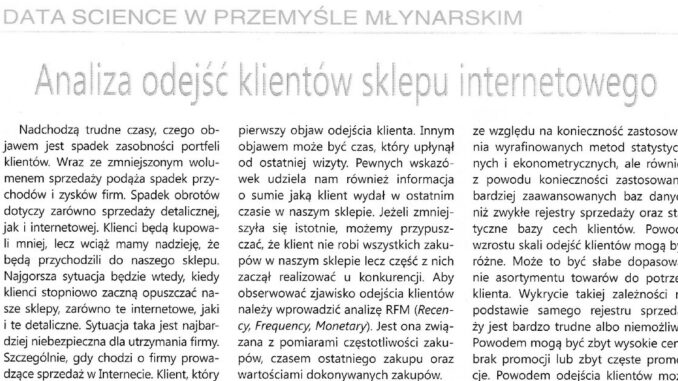
Customer Churn Analysis in an Online Store
Difficult times are approaching, one sign of which is the declining purchasing power of customers. A decrease in sales volume is followed by a decrease in companies’ revenues and profits. The decline in turnover affects both retail and online sales. Customers will buy less, but we still hope that they will continue to visit our store.
The worst situation will arise when customers gradually begin to leave our stores, both online and retail. This situation poses the greatest threat to a company’s survival, especially in the case of companies selling online. A customer who leaves an online portal once is unlikely to return. Customers show a greater tendency to return to retail stores. It is therefore necessary for e-commerce companies to create customer-retention systems.
CHURN analysis is called customer attrition analysis in Polish. It concentrates on tracking customers who leave an online store. It examines the rate at which customers leave the store, measures the amount of lost revenue and attempts to find the reasons for the phenomenon.
Customer attrition is very costly because it entails the cost of acquiring new customers. New customers must replace those who have left; otherwise, the company will lose revenue, the share of fixed costs will rise and the online store will face the risk of declining profitability. It is therefore extremely important to understand the causes of customer attrition. They can be identified by applying statistical and econometric methods.
W-MOSZCZYNSKI-2023-3-25The first indication that a customer is gradually leaving may be a decline in the frequency of their purchases. If a customer had for a long time regularly bought from our online store every week and suddenly began buying once a month, this is the first sign of customer attrition.
Another indication may be the time elapsed since the last visit. Information about the total amount the customer has recently spent in our store also provides some clues. If it has declined substantially, we may suppose that the customer is no longer making all purchases in our store but has begun making some of them with competitors.
RFM analysis
To observe customer attrition, an RFM analysis—Recency, Frequency, Monetary—should be introduced. It involves measurements of purchase frequency, the time of the most recent purchase and the value of purchases made.
RFM analysis consists in assigning particular customers defined characteristics within predetermined ranges. Each customer will therefore be described by characteristics assigned to them and grouped into classification intervals. In the case of average expenditure, these might be three classes: “customer spending up to PLN 500 per month”, “customer spending between PLN 500 and PLN 1,000 per month”, and “customer spending more than PLN 1,000 per month”. A randomly selected customer could be described as follows:
Monetary: “customer spending up to PLN 500 per month”;
Frequency: “visits the online store once every two weeks”;
Recency: “customer who last visited the store between 6 and 10 days ago”.
RFM analysis should be carried out frequently enough to observe customers who have changed their usual class or characteristic. Information that a customer has reduced the frequency of store visits or substantially reduced the average value of weekly purchases may be crucial for taking preventive measures intended to stop that customer from leaving.
Identifying the reasons for attrition
Identifying the true reasons why customers leave can be a very difficult task. This is not only because sophisticated statistical and econometric methods must be used, but also because databases more advanced than ordinary sales registers and static databases of customer characteristics are required.
The reasons for an increase in customer attrition may vary. The range of goods may be poorly matched to the customer’s needs. Detecting such a relationship from the sales register alone is very difficult or impossible. Prices may be too high, promotions may be absent or too frequent. Customers may also leave because the website lacks the appropriate functionality.
In the last case, identifying the problem is relatively simple. If we observe customer attrition and suspect that it was caused by a recent modification of the website’s functionality, we can conduct an A/B test to clarify the situation. Finally, customers may leave because of active measures taken by competing online stores. Each reason for customer attrition requires a different method of identification.
One common reason for leaving online stores is the absence of suitable prices or an appropriate offer. An ordinary online-store sales register contains every completed transaction, but it does not contain information that a customer entered the store and left without buying anything.
To determine whether a customer intended to buy but withdrew from the transaction after seeing the price, we must have a register of customer visits and a history of their movement through the store. Most customers have particular habits. If a customer historically always entered a given department and viewed a specific range, which ended in a purchase, but does not now buy, this may mean that the price or range is no longer suitable for them. By analyzing browsing history, the degree of each individual customer’s sensitivity to price changes, promotions, absence of promotions and unavailable assortment can be examined.
Survival analysis
This analysis was invented to examine the survival rate of patients subjected to different medical therapies. For example, people suffering from tuberculosis could be subjected to four different therapies. From the results of survival analysis it was possible to determine the average probable survival time of patients for each therapy used.
Survival analysis is successfully used to analyze customer behavior. The introduction of loyalty cards, bonuses, individual promotions and participation in competitions can contribute substantially to increased customer retention. Survival analysis can precisely determine the effectiveness of individual methods intended to retain customers in an online store.
Summary
The importance of online sales is now increasing. Online sales permit the use of sophisticated analytical methods because the entire purchasing process takes place in a virtual world and every event occurring in that process is recorded. These methods can substantially increase sales or help maintain customer loyalty.
It is necessary not only to use modern data-science analytical tools, but also—and perhaps above all—to have an appropriate architecture for collecting and storing data associated with the purchasing process.
Wojciech Moszczyński — graduate of the Department of Econometrics and Statistics of Nicolaus Copernicus University in Toruń; specialist in econometrics, finance, data science, and management accounting. He specializes in the optimization of production and logistics processes. He conducts research in the area of the development and application of artificial intelligence. For years he has been engaged in the popularization of machine learning and data science in business environments.
Dodaj komentarz