
February 2022 | Przegląd Piekarski i Cukierniczy (Baking and Confectionery Review)
Automated machine learning
At present we are witnesses to a great technological revolution in the area of information processing. We have heard this many times from various sources. What does this — fundamentally rather banal — piece of information give us? Actually, probably nothing, apart from unnecessary stress. Somewhere not far away, some developmental processes are happening, some revolutions and generational changes. We do our own thing, we bake bread, we drive it to the shops. We try to keep our employees at a time of a general shortage of hands to work. We lose sleep over gigantic increases in gas and electricity prices, inflation, and new, enigmatic tax regulations. In the face of all these misfortunes, do we also have to stress additionally over some computer revolution?
Why does the technological revolution stress us?
Each of us is an expert in our own field. We know, however, that the world moves forward. Once, in 19th-century England, there existed a very strong transport lobby, gathering the owners of mail coaches. They tried to block the development of the railway. The appearance of Joseph Jacquard’s automatic looms led to the collapse of small, until then perfectly prospering weaving workshops. Unfortunately, some revolutions keep appearing and turn whole industries upside down, force people to change, negate the entrenched order of the world. Of course no „some” computers will start baking bread for us or making digital competition for us in producing cakes.
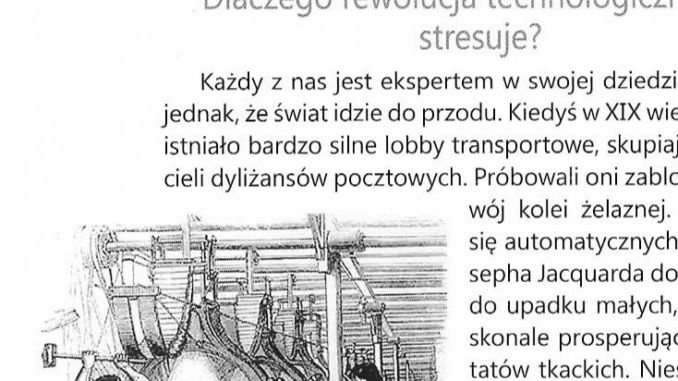
A drawing from the beginning of the 19th century showing Luddites destroying machines in a weaving-loom factory. Source: Photographic Archive of Piotr Stańczak.
W-MOSZCZYNSKI ppic 2-22However, the appearance of new solutions carries with it the threat that someone will be better adapted than us. We do our own thing, we bake bread, we sell it and we face numerous adversities of fate. We do our job well and we earn money. Despite these reassuring thoughts, we are nevertheless aware that this „some” revolution may change the world for us to such an extent that we will have to pack our bags.
Does this revolution threaten us?
The revolution we are talking about has recently accelerated a great deal because of the pandemic. Last year’s lockdown caused a significant growth in internet sales and the popularisation of mobile apps and services. This is a direction which, contrary to appearances, may threaten us, because it concerns communication and sales. If we ourselves do not sell, someone else will do it for us. Of course they will also take away our margin. If we stick to well-worn patterns, we may over time decline financially.
A simple example: we have a chain of bread shops. Unfortunately, the popularisation of remote work has reduced the traffic of customers commuting to work. Customers do not leave home, they order products over the internet. So we have a problem: someone else delivers our bread to homes for us. We pay rent for shops in good locations, employees’ salaries and the costs of returns. Some other company handles the sales practically without costs and takes a good part of our margin.
Another simple example: someone has opened a nice internet shop. They provide the customer with an integrated service: they book the venue and staff for special occasions, accommodation and catering. Of course they also sell our cakes and gateaux. Instead of coming to our confectioner’s shop, the customer prefers to click everything through without even leaving home. On top of that they get a discount, which comes at the expense of our margin. We can be offended at the market, but unfortunately the world moves forward, and we either get on the departing train or we stay on the platform. An internet company whose share capital is equal to the value of an old computer with a few free apps from the internet eliminates us from the market. Us, who pay fat millions for machines, employees, fixed costs and fuel. The honest man always has the wind in his face and so on… we can always complain.
What can we do to enter the stream of change?
Firstly, in order to overcome a problem, one first has to identify and understand it. To get to know the specifics of the changes and adapt to them. After all, development is not created against someone, but for someone. We, having resources and knowledge, can make use of the potential dormant in the new tools.
It is easy to notice that a great deal has changed. Once, cars were repaired by oneself with „hammer and chisel”. Today every repair begins with computer diagnostics. Nobody tries to tinker with the engine on their own any more. There are areas of service where it does not pay to take on the work oneself. Nobody nowadays tries to do their own accounting or repair expensive leased confectionery machines by themselves.
The website
In the era of the pandemic, the importance of the internet has grown extraordinarily. Today the internet is a parallel world. We cannot not be in it. Unfortunately we ourselves must enter it. Today nobody should pay for a presence on the network, just as nobody pays for a presence in the real world.
Once, creating and running one’s own website required the help of an IT company. Today, any child will create a website on Facebook within a few minutes. Interactive internet shops can be created by oneself and completely free of charge. What is interesting is that a website made in this way within an hour is usually no different from sites made by experts employed for a fat sum by large corporations. There is a countless number of free templates which will make our site breathtaking. It is enough to type into a search engine: Free WordPress Themes, in order to convince oneself how many possibilities today’s technology gives us. In further articles in this series we will learn how to make and run a website or internet shop by means of free mobile applications.
Advertising videos and infographics
Another thing we should notice is cultural changes in the area of communication. Today people more often reach for pictorial or video information. Dry press advertisements or street posters no longer reach them. The importance of traditional media is progressively shrinking in favour of internet media. One picture is worth a thousand words. Today anyone can have a YouTube account, and for free. Once, filming an advertising video required a camera, an editing studio and specialist knowledge. Today everyone carries a high-class video camera in their pocket, and a professional film studio is available after a few mouse clicks. Importantly, video editing takes place online and anyone can do it. In further articles I will explain step by step how to create an advertising video, what is important and what has to be avoided. I will indicate the most popular apps and give many interesting tips. We will also deal with creating infographics, an important element of communication with customers.
Databases and analytical systems
Sometimes we need something more than advertising or an internet shop. In order to understand the market well, to obtain a competitive advantage, one sometimes has to go a little further. Software creators have also foreseen this situation. On the market there function a great many free database systems. There we can keep our own data resources on customers and employees, contracts and vehicle characteristics, journey times, delays and fuel consumption. Without any IT preparation we can maintain complex databases, instead of doing this in notebooks or spreadsheets. We also have at our disposal many free programs for presenting data and quantitative analyses. In further publications in this series we will learn about the newest solutions in this area. We will learn about programs in which the knowledge required is not much greater than the knowledge needed to use Facebook.
Automated machine learning
It would be untrue if I wrote that today’s computer revolution concerns only the internet. Of course the most important element of the technological revolution taking place before our eyes is artificial intelligence. Visionaries, the founders of great IT corporations, believe that in the not-too-distant future everyone will program. However, this programming will not be what we know today. It will be voice programming, not by means of typed code.
Before we reach the areas of science fiction, let us see what is here and now. If we knew how much flour would cost next month, or knew the approximate exchange rate… A forecasting model would come in handy. In order to make one, one has to employ a very expensive expert, then keep them on, because someone has to update the model. On a small scale this does not pay off at all. But the situation is not hopeless. Software producers have invented something called automated machine learning for creating forecasting models. This software requires no qualifications, and anyone who needs a model can make one for themselves. Unfortunately AutoML programs are not yet free. ML robots are also inferior to the intelligence of real experts, though over time this will probably change too. In further publications I will also discuss this aspect of technological development.
The essence of the computer revolution is the popularisation of advanced digital processes, such as communication and the access to and processing of information. Until recently these were areas reserved for a technological elite. At present, the simplification of applications and their free character have led to the spread of access to creating very effective means of communication and analysis. A kind of democratisation of the digital world has taken place. A world in which everyone has equal chances.
Wojciech Moszczyński
Wojciech Moszczyński — graduate of the Department of Econometrics and Statistics of Nicolaus Copernicus University in Toruń; specialist in econometrics, finance, data science, and management accounting. He specializes in the optimization of production and logistics processes. He conducts research in the area of the development and application of artificial intelligence. For years he has been engaged in the popularization of machine learning and data science in business environments.
Dodaj komentarz