
A Seventeen-Thousand-Dollar Robot Has Just Opened a Confectionery: No License, No Social Security, and No Inhibitions
For twenty years you got up at four in the morning, had flour under your fingernails, burns on both forearms, and one certainty in your head that kept you alive more strongly than coffee at five: no one will take this away from me, because no one can do it the way I can. Decorating a five-tier cake with sugar-paste flowers, ganache on a perfectly smooth surface, chiffon sponge cakes that always turn out the same because you feel the dough with your hands, not with a scale.
Those were your things. Your trade. Your advantage. Your retirement. And this is precisely where I have to tell you something that feels a little like entering a room and seeing that someone is already sitting in your chair, eating your dinner, and does not look remorseful at all.
The advantage of your artistic confectioner’s hands is disappearing. It will not disappear in five years. It will not disappear in a decade. It is disappearing now, incidentally, in passing, almost by accident, and no one has made a moving documentary series about it.
However, so as not to end with a description of this picturesque catastrophe—because this industry has enough problems without my efforts—I will also say that the same movement that closed one door opened another, and opened it very wide. The person who understands this first can build something completely new. This is not something comforting for real confectioners. First, however, we need to talk about a robot that skates.
A Robot Skates. The Internet Shouted: Fake. It Was Not Fake
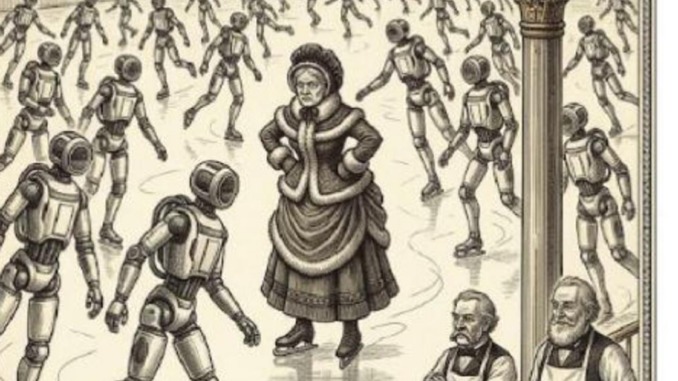
A few weeks ago, a recording appeared online that divided people into those who watched it and panicked, those who watched it and decided it was fake, and those who did not watch it because the algorithm showed them something about cats. The recording shows a humanoid robot roller-skating across a smooth surface, performing a 360-degree turn in the air, landing on its wheels, and continuing without stopping, freezing, or experiencing any of those moments of panic familiar to every person who has ever tried to stand on roller skates and discovered that their legs suddenly have their own opinion about the direction of travel. Then, as if this were not enough, the robot puts on ice skates and does the same thing on ice, because ice is obviously a much less demanding surface than a hard floor.
The comments came immediately: it is CGI, it is slowed down, it is a person in a costume, it is an AI animation. None of these answers was correct. It was a real robot, operating in real time, without any editing modifications. Nor was it some mysterious machine taken from a government laboratory, with ten years of development behind it and a price equal to that of a small airport.
This robot is called the Unitree G1. It is manufactured in Shenzhen, China. It weighs 35 kilograms, is 127 centimeters tall, has up to 43 joints depending on the configuration, and costs USD 17,990. At today’s exchange rate, that is approximately PLN 70,000—the price of a decent used car, or a slightly outdated showroom BMW with one previous owner who “only drove it to work,” which in Poland usually means one hundred thousand kilometers on the odometer and an interesting accident history. That is the price of a machine that learns new skills in a few hours and can immediately transfer them to all its brothers around the world.
Before we get to why you, specifically, as a confectioner, should know about this, we must understand where this ability to learn comes from, because it is the most astonishing part of the entire story. It simply changes the rules of the game in a way that even the boldest forecasts could not predict three years ago.
A human learns by falling. A robot learns through a simulation of a million falls completed within an hour in a computer’s virtual environment.
Imagine for a moment how a person learns to ice-skate, because this is the metaphor that best explains the entire difference. A child standing on ice for the first time does something very specific: falls. Falls once, gets up, falls twice, gets up, falls fifty times, gets up with an increasingly frustrated expression and growing suspicion that perhaps this activity is not for them after all. After some time, after hundreds of falls and long weeks of uncertainty, the child can do something—something that cannot be transferred to another child through words, because it is muscular knowledge, knowledge of the body. The human ability to skate has a history of 5,000 years, because the first skates made from animal bones were invented roughly that long ago. For all those 5,000 years, every generation had to learn again, from zero, from fall number one, because knowledge of the body cannot be transferred like a PDF file.
The robot learned differently from us humans. Engineers created a virtual environment—a computer simulation of physics in which gravity pulls just as it does in reality, ice has the same friction as a real rink, and momentum and inertia operate exactly as they should. Into this environment they placed a virtual model of the robot, with all its joints, motors, weights, and mechanical limitations, and let it try to skate.
The first attempts were catastrophic. The virtual robot fell. It fell a thousand times, a hundred thousand times, a million times. Every fall became data; every failed attempt to maintain balance became information for the system about what did not work; and every successful correction, however minimal or accidental, became a signal that the system strengthened and remembered. Nor was this one virtual robot trying a thousand times in sequence, because that would have been too slow. Thousands of virtual robots were trying simultaneously, in parallel, each in its own virtual environment, while the computer accelerated time so that hours of simulation corresponded to years of human practice. After several hours of this training, the system had a finished algorithm—a ready sequence of movements, corrections, and weight shifts describing how to maintain balance on ice. They uploaded this algorithm to the real robot. A robot that had never physically stood on ice and had never had an opportunity to fall in reality could skate immediately, because it had already done so a million times in simulation.
When one person learns something through years of hard work, only that person possesses the skill. The person will die, and the skill will die with them unless they pass it on through decades of teaching successors, who must themselves travel the entire road from the beginning. This is the fundamental fragility of human knowledge, and it applies to everything: from peak athletic achievement and mastery of a craft to the precision of a surgeon who has operated for thirty years and whose hands are a tool worth millions—but only until retirement.
When one robot learns something through several hours of simulation, that skill can immediately be copied to every other unit of the same model on the planet. One robot learns to skate, and the next day all of them can skate.
Why Hyundai Rather Than a Silicon Valley Laboratory?
Here a theme emerges that most commentators overlook because it is less obvious and requires an understanding not only of technology but also of industry. One might ask: why do robots that genuinely change the game increasingly come either from China or from car manufacturers, rather than from all those hoodie-wearing startups that spent the last ten years raising millions of dollars to build robotics from scratch? The answer is prosaic and slightly amusing: an industry that spent a hundred years learning to manufacture things on a mass scale, cheaply and durably, simply transferred this knowledge into a new field, while everyone else would have had to build it from zero.
Hyundai purchased Boston Dynamics several years ago. Hyundai is a company that spent decades perfecting the art of mass-producing complex mechanisms that must operate reliably for years, under extreme conditions, with repair costs that an ordinary user rather than a government laboratory can bear. Engines, powertrains, steering servomechanisms, sensors, suspension-balancing systems—Hyundai manufactures all of these in millions of units per year, tests them according to standards stricter than anything the robotics industry would have to invent from scratch, and services them globally through a dealer network present in every larger city.
Here is a detail that is a small gem and illustrates the entire approach: the legs of the Atlas robot are driven by servomechanisms taken directly from the steering systems of one of Hyundai’s mass-produced models. These are not special, robotic, astronomically expensive components. They are parts manufactured in millions, available from a spare-parts distribution center, and tested across hundreds of thousands of kilometers of operation by ordinary drivers before they ever reached a robot. The durability of these components is known, predictable, and supported by real-world usage data rather than accelerated laboratory tests intended to imitate life.
This is an advantage that cannot be bought. A company building robots from scratch must devote years and billions of dollars to reaching the point from which Hyundai begins. Toyota is watching. Volkswagen is watching. Stellantis is watching. In a few years, the automotive industry will also be a robotics industry—not because cars and robots are the same, but because the mass production of complex mechanical systems is the same competence, and that competence sits deep within the DNA of companies that have spent a hundred years building things that must work, must be inexpensive to repair, and must survive use by someone who does not read the instruction manual.
The Entry Barrier That No Longer Exists. We Apologize for the Inconvenience
Let us return to the confectionery business. For years, an entry barrier protected masters from amateurs, and it was a solid barrier because it resulted from something that could neither be bought nor shortened: skill. It was not premises, because premises can be rented, and a kitchen with back rooms in a small town can be rented for PLN 2,000 per month, together with an oven, racks, and a worktop. It was not a certificate, because in online sales a certificate is a piece of paper that no one looks at before clicking “add to cart” and entering card details. It was not a website, because any AI assistant can build a website in fifteen minutes, hosting costs PLN 150 per year, and no technical knowledge is needed—just some patience and access to a credit card. It was not even delivery, because courier companies specializing in transporting short-shelf-life food have operated for years, reach everywhere, and charge rates that can be calculated into the product price.
The barrier was skill. The confectioner-artist learned the trade for years and then for decades, and the knowledge resided in the confectioner’s hands, eyes, and ability to judge the consistency of sugar paste by touch before seeing the result; to sense the exact temperature at which jelly can be used without running; and to draw lines with a chocolate pen that look as though they were drawn by someone who had drawn nothing else for twenty years. This knowledge had no market price that could be outbid, because it simply could not be purchased within a year. Recipes could be purchased, courses could be completed, and one could even undertake an apprenticeship with someone good, but between the craftsman and the master there was always a gulf of years, and that gulf was the barrier.
How It Really Works—Without Romanticism
The scenario is painfully simple. Someone—who need not have any confectionery education—decides to sell celebration cakes online. The person registers a business, rents a kitchen with back rooms for PLN 2,000, perhaps from a local bakery that does not use it on Saturdays and Sundays anyway, and builds a website with beautiful photographs of cakes. AI generates those photographs before the first sponge cake has even been baked, and they look better on the website than phone photographs taken in a kitchen against the background of an apron. The person signs an agreement with one of the courier companies handling food deliveries and is ready.
Wait a moment. This person still cannot decorate cakes.
And this is where the robot enters.
A Unitree G1 for PLN 70,000—yes, the same model that recently chased wild boars through the center of Warsaw. It does not have to be purchased; it can be rented from someone who bought it for other purposes, such as warehouse work or packing parcels in a logistics hall, where it performs standard tasks throughout the week. On Friday evening, the robot enters the rented kitchen. The kitchen owner logs on to a software-leasing platform—a cloud service—and purchases weekend access to a package of confectionery skills: precise decorating, working with sugar paste, coating with ganache, writing with chocolate, and assembling sponge-cake layers. These skills were previously learned by one robot in simulation—thousands of hours of virtual practice compressed into several actual hours of computation—and are now available as a cloud service, in exactly the same way as one can buy a Netflix package for several selected films today.
The robot works through Thursday and Friday night, fulfilling orders placed by customers through the website. It does not need coffee breaks. It does not need sick leave. It is not in a bad mood, because it has no mood at all, which is a disadvantage in some working environments. There are no cables lying around on the floor. Every two hours it puts a depleted battery into a charger and removes a charged one, which takes four minutes and requires no human intervention because the mechanism is fully automated. Over a full day it consumes as much electricity as a vacuum cleaner, so the energy cost for the entire weekend’s work is several dozen zlotys—not several hundred or several thousand.
Early on Saturday morning, the courier company arrives and collects the cakes. The software lease expires. The robot returns to the hall, where for the next five days it sorts parcels, sweeps, and performs other routine warehouse tasks for which its owner charges the logistics facility. The following week, the same scene repeats in the rented kitchen.
Here we reach the heart of the matter, which is somewhat philosophical but important: the person who rented the kitchen, website, and robot is not a confectioner. The person completed no training. They have no idea what properly worked sugar paste tastes like. They could not personally decorate even the simplest birthday cake in a way that could be posted online without the caption, “remote work, unfortunately.” Yet their cakes turn out perfectly because the robot possesses skills that the person does not and will not possess.
Thirty Years to Teach a Human
Several hours to teach all robots. A person who becomes a master in a field devotes years to it. A confectioner who spent twenty years perfecting work with sugar paste spent twenty years analyzing mistakes, correcting technique, developing a feel in the hands, learning from older masters, and teaching younger apprentices. This knowledge is indisputably valuable, deserves respect and recognition, and its possessor has every right to be proud of it. Yet this knowledge has one fundamental weakness that no effort or merit can overcome: it is local and fragile. When this person retires or dies, that particular combination of experience, intuition, and sensitivity that made them a master disappears forever. The apprentices learned much, but not everything, because not everything can be communicated through words and demonstration; some knowledge lives only in the master’s hands.
A robot-master—which works as a warehouse worker in its day job—does not have this problem. When one robot, after thousands of hours of simulation, reaches a level corresponding to thirty years of human practice in a field, that level never disappears. It is encoded in an algorithm. The algorithm can be copied, stored, and sent to any robot of the same model anywhere in the world, and that robot will immediately perform the same task at a master’s level. It can be rented as a service, purchased, or upgraded to a newer version if better techniques appear. Knowledge does not die. Knowledge grows, accumulates, and is available to everyone simultaneously.
Consider for a moment what this means for confectionery. If one robot achieves the precision of the world’s best surgeon, every hospital in the world can have the same level of precision the next day. If one robot reaches a master’s level in weaving Persian carpets that are unavailable today because the masters die without leaving successors, that level is preserved and available to everyone with the right equipment. If one robot is the world’s best sniper, the next morning every robot in that family shoots just as well. There is no limit on the transfer of this knowledge, no degradation of quality when it is copied, and no apprentices who learn less well than the master. There is an algorithm, there is an update, and there is mastery for everyone.
We humans simply have no chance of competing with this mechanism in fields requiring manual, precise, and measurable skills, just as we have no chance of racing cars in terms of speed or endurance. The master-craftsman robot, working at reception in its day job, belongs to the same category: without barriers and without feelings, simply a machine.
What This Means for Bakeries, Confectioneries, and Everyone Who Sells Online
Let us return to practice, because theory is interesting, but confectioners are pragmatic—and rightly so.
Three years ago, people would have told you that you could not enter the artistic-cake market without many years of experience, and they would have been right. Two years ago, they would have said that without natural artistic talent you could not create sugar-paste designs that anyone would buy, and they too would have been largely right. Today, that barrier is lower. In a year, it may practically cease to exist.
This is not merely news for someone only considering entering the industry, although it is obviously very important news for such people. It is primarily news for someone already in the industry, because if this barrier disappears, the playing field and the rules of competition change. When everyone can have a robot with a master’s skills, manual ability ceases to be a market differentiator. Something else becomes the differentiator: an idea, a story, a relationship with the customer, unconventionality, a niche—everything that a robot can execute with technical perfection but that a human must first conceive before the robot can do it.
A confectioner with twenty years of experience who builds a brand around that experience—around their own story, philosophy, and interpretation of tradition—can survive and even win in the new world, because customers will continue to buy the story together with the cake. A confectioner who believes that their market value consists solely of the technical ability to decorate is in a more threatened position, because the robot will take over that technical ability more quickly than a typical retirement-planning cycle lasts.
There is also a third possibility, one that is rarely considered because it requires a little courage and imagination: do not fight the robot; employ it. A baker or confectioner who understands what the robot can do and how skill leasing works can become someone who builds a brand, devises products, and manages quality while the robot carries out production. This role combines industry knowledge with an understanding of new technology, and that combination is rarer today than an albino among albino ravens, because most people in the industry either know nothing about robots or know something but are afraid, while most technology people know nothing about confectionery.
The person who understands this earlier has doors available that others will see only when those doors are slammed in their faces.
I am not writing this to frighten you, although a little fear is healthy in this context, just as a little fear of driving without a seat belt is healthier than its complete absence. I am writing because the rules of the game are changing, and the change is rapid enough that the difference between understanding it now and understanding it in three years may be the difference between being a player and being a spectator.
A new robot costs as much as a poor used car and can learn to skate in a few hours. In a year it will cost less, because production and competition are growing. In two years the skill-leasing ecosystem will be more developed and will encompass dozens of industries rather than a handful of experimental applications. In five years, today’s PLN 70,000 may look the way the price of the first laptop from the 1990s looks today, prompting amazement that people once paid so much for it.
Work as a Privilege
Work as a privilege, rather than a given. This is the direction indicated by economists, demographers, and labor-market analysts. Most agree that automation will accelerate and that occupations protected by manual skill and precision are not exempt from this logic. Occupations requiring social context, relationships, conceptual creativity, and an understanding of human needs extending beyond patterns in data remain protected—at least for now. A confectioner who is an artist has different options from one who is solely a technician.
Welcome to the new, partially robotized world. There was a moment, perhaps five years ago, when everyone was certain that robots might take over welding in factories and moving pallets, but that handicrafts, precision, artistry, and the creation of beautiful things requiring touch and many years of knowledge would remain safe for a long time. That moment has just passed. Some awkward machine made of sheet metal and servomechanisms taken from Hyundai steering systems has just learned to decorate cakes, and it did so faster than a year of study at a confectionery school.
You can continue getting up at four in the morning. That is your choice and your right. It is simply worth knowing that the robot gets up at four, at five, and at six, and it does not complain, smoke cigarettes during a break, or take sick leave in December before Christmas. More importantly, it is worth knowing that someone who understands how the robot works can make it work for you rather than instead of you. This is one of those situations in which knowledge truly ranks first among the things worth investing time in.
Wojciech Moszczyński
Wojciech Moszczyński—a graduate of the Department of Econometrics and Statistics at Nicolaus Copernicus University in Toruń, a specialist in econometrics, finance, data science, and management accounting. He specializes in optimizing production and logistics processes. He conducts research into the development and application of artificial intelligence. For years, he has been involved in popularizing machine learning and data science in business communities.