
Do niedawna zbudowanie własnej aplikacji oznaczało wielki zespół, wielodniowe uzgodnienia, ogromny budżet i brak gwarancji, że cokolwiek zadziała. Autor pokazuje, że sztuczna inteligencja zmieniła ten paradygmat: pojedynczy ekspert, otoczony asystentami AI, potrafi dziś zbudować aplikację od pomysłu do wersji produkcyjnej w dwie godziny i za grosze. Artykuł opisuje na konkretnym przykładzie — systemie rozpoznawania numerów rejestracyjnych — jak wygląda taki proces w praktyce, ile realnie kosztuje, i dlaczego mimo wszystko nie każdy jest w stanie to zrobić: sztuczna inteligencja wykrywa niekompetencję i dostosowuje się do rozmówcy.
I Can Write Any Application You Can Dream Up. Now the Greatest Barrier Is Your Imagination
You have a great idea for implementing an application based on an artificial intelligence assistant. Such an application could save tens of thousands of złoty a year, could bring additional profits, could shorten delivery times. There are countless ideas — but you know how it goes.
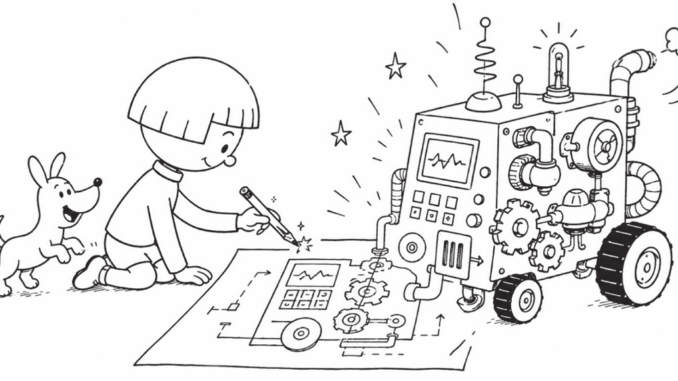
How nice it would be to have a magic pencil, to draw something and have it start working, straight away, without errors, without waiting, without costs and without arguments.
You are aware that there already exist systems which can do something like this. You are aware that there are people who are capable of doing it. Unfortunately you are also aware that this is a cosmic investment: expensive, lengthy and very exhausting. And the worst thing in all of this is that you do not know whether it will come off at all, whether it will work. It is not a matter of your idea — you do not know whether it will work technically, whether there will be people who will demand payment and at the same time fail to deliver. You do not know, so you wait. Maybe something will change. But if you wait a long time, your idea will cease to be sensational, and your competitor will do it better: they will take the risk upon themselves, will produce an application like yours or better, and you will lose your competitive advantage. So you wrestle with your thoughts: how to get around the technological difficulties, the reefs, the conversations with contractors? How to talk with people who treat you like a technological dilettante? How not to let yourself be cheated? How to obtain the application of your dreams? The good news is this: at last a breakthrough has come. At last your dream can be realised.
Who is going to make it for me?
I can write any application you can think up for yourself. Can one imagine a more impudent, self-satisfied statement, testifying to an excessively exuberant faith in one’s own powers? But is it really an impudent and shameless statement? Let us look at the present times. Technology is changing so fast that even those who are deeply immersed in it — I am speaking here of the development of artificial intelligence — are not up to date. It is enough to take two weeks off from the novelties, not to take an interest, not to read, and after two weeks it looks as though we had crawled out from under a stone.
Writing about novelties in the world of artificial intelligence has become a risky occupation. One can describe something as a leading technology, and then, two weeks later, when the article is published, it turns out that this technology is already obsolete. I am not exaggerating — such a pace has become the new reality of development.
So as not to waste time on monologues of little value and on being enraptured by something which has become commonplace, let us assume: the introduction of artificial intelligence has become the same kind of technological carrier as the introduction of electricity once was. At one time the majority of devices were driven by water or wind. Then the steam engine appeared and the majority of devices ran on steam. And this technology — revolutionary and exceptional — at a certain moment became simultaneously a barrier to further development. For how can one build a vacuum cleaner running on a steam engine? A washing machine, a calculator or a computer running on a steam engine? Nothing will work. It was simply a blind alley.
The further development of humanity was unblocked by the introduction of electrical energy: the light bulb instead of the paraffin lamp, the electric motor, control devices, the telephone and the radio. Practically all the devices which surround us are electrical — there is no other carrier of energy any more. And these devices are once again the end of development, a wall. One can have a more modern vacuum cleaner, a more modern computer, but it will still be the same computer with the same efficiency, without any greater breakthrough. Humanity had to think up something which would be the next carrier of development. That something is artificial intelligence.
I can write any application for you, in a short time, for little money, and the only barrier which stops me is the lack of an idea on your side.
How can he be so impudent? After all, in order to write an application one has to set up a team. The team had to be well motivated, because it had to consist of very highly qualified, excellently paid specialists spoiled by the corporations: IT specialists, data scientists and engineers. Such a team needed a boss, a so-called project manager. Every project begins with days of deliberations, budget agreements, discussions about the architecture, the environment, the data. There are so many agreements to be made that practically no client is able to endure them, and since the arrangements were not very precise, companies could run their projects for a long time and insist that „after all, that is what we agreed”. In a word: extravagance, bureaucracy, a never-ending process of agreements, tests, mistakes, slippages in delivery dates and the covert self-improvement of the team members at the client’s expense. Long, expensive, and with no guarantee that it will work at all.
Such a state of affairs was accepted as the standard, the norm of operation and the synonym of a professional implementation process. Many people, many papers, many agreements, much noise. Expensive, lengthy, difficult.
Let us imagine that we have built a house in a shell state and we need made-to-measure windows — wooden, oak, double, with dense glazing bars. So we go to a corporation which deals professionally with such windows, we present the drawing and… the agreements start rolling in: environmental standards, carbon footprints, hard-to-predict consequences connected with use, analyses of the strength of the panes. After several weeks of agreements the company presents a design for the windows which differs substantially from what we wanted, but we already want to speed things up and start production. A team of the most outstanding experts assembles: one is responsible for cutting the panes, a second for impregnation, others specialise in frames and metal elements. Madness? Yes, madness. That is exactly what the realisation of technological projects looks like today — that is to say, up to today, or perhaps up to yesterday.
The craftsman versus the corporation
The example of made-to-measure windows is a transposition of the real treatment of clients and the real process of creating applications carried out by large, specialised IT firms. So let us try to continue our example with the windows. We come to the conclusion that perhaps after all we can avoid having these windows made to measure, and simply buy a standard window from a manufacturer. A great idea — it turns out, however, that the window does not fit: here three centimetres are missing, in another place seven, and besides, the glazing bars do not match the elevation at all. These are not at all the windows we want. This is an allusion to boxed applications, which can be bought as a ready product. We have some idea, and in the box there is something, some program, a similar program, but cheap and available at once. It is a bit like bread from a discount store: we wanted a sourdough loaf, and we get something which has a crust, a crumb, even smells nice, but it is not the bread we had in mind. We wanted to buy a dog, and out came a rabbit: it has four paws, it has ears, it has a nose and it is even pleasant to the touch, but it is not a dog, it is a rabbit. It does not bark at strangers; it exists, but it is not what we wanted.
So then we come to the solution. Since the company specialising in making windows was too expensive, too bureaucratic and too greedy in its costs, and the boxed solution turned out to be completely unsuitable — despite being many times cheaper and intensively advertised — we find a carpenter somewhere in the countryside who has spent his whole life making windows. And he makes these windows for us. The time spent on agreements is perhaps two hours; practically all the details are already on the technical drawing. We agree a date and after a few weeks we collect a complete set of windows exactly as we wanted them. It is excellent. So why did we not start by going to a normal craftsman who would do it? And here lies the heart of this article.
Up to now there was no such craftsman on the IT market, one who would be able from beginning to end — from the idea to the closing — to make an application by himself. Those who undertook the independent execution of such a made-to-measure application were called craftsmen, bunglers. It was a synonym for an unprofessional solution, colloquially known as a makeshift job. And there was something in this, because it was difficult for one person to handle everything without errors and stumbles.
However one looks at it, IT technology, artificial intelligence, data science, database and environmental solutions are terribly complicated, and in this world there was no such thing as the equivalent of the village craftsman who knows his trade perfectly and makes windows like an artist — just like an experienced baker who, out of flour, water and sourdough, can conjure up a loaf you will not buy in any supermarket.
Up to now — which means that this has already changed. At present practically every expert who had a higher awareness of creating applications, that is, who was aware of the architecture and the costs of solutions, is able to build an application independently. Now — as I mentioned — thanks to the introduction of artificial intelligence such people and such possibilities have appeared. These possibilities are changing the whole industry before our eyes. Now it is the IT corporations producing programs that are beginning to have problems. They are not able to compete on quality and price.
A one-person company doing the work of hundreds of people
I do not want to go into details, because that is not the point. The point is that once — up to today, up to yesterday — companies, in order to develop, needed people. More people. Still more people. People brought added value; added value was not brought by new computers, chairs and rooms, but by people. People were therefore the carrier of development.
Now people have become the blocker of development. If a company employs 100 people, then to a large extent they will be performing work which could be performed by AI assistants at a fraction of their cost. Economics is ruthless and merciless. It sinks every instance of wastefulness.
What is an AI assistant? It is a programmed robot which in its work behaves identically to a human being: it answers e-mails, answers difficult questions, searches for answers, converses for hours on end, writes, creates code, creates applications, tests applications — and it does this 24 hours a day. In truth, the work which a human being performs over a whole day, it performs in 10–15 minutes.
We can make use of ready-made, pre-programmed assistants, such as OpenClaw or Hermes, or create an assistant ourselves. An assistant really differs very little from a human being. What does „very little” mean? Obviously it is better than a human: it has no second thoughts, it does not cost too much, and it can work 24 hours a day all week, it can answer very complex questions and will never hesitate in its answer, will never forget, will not take offence and will not resign. It does not waste time on coffee and on pretending to be doing something. It depends only on us how reliable and effective this system will be. If we are able to build synthetic people who work for us, then by means of these synthetic people we can also build any application we can think up.
What it looks like in practice
In practice it looks like this. I notice that I need in my work, for example, a system which will recognise the registration numbers of cars entering my company. A nice idea, but how to realise it? I turn to a typical chat and for a dozen or so minutes, perhaps for two hours, I talk with it about the technical possibilities and about the fixed costs of using such an application. At the end I create an instruction for building such an application. My chat and I, from my telephone, created an outline of the application; the result of this work is an instruction on how the whole device for reading registration numbers is to function. We go to the factory. By factory I mean the place in which the application is created from beginning to end. In my case I use the Google Antigravity 2.0 factory. This place resembles a workshop, and in a workshop there is usually somebody who is the foreman. I talk exclusively with the foreman: I set up the project and send him the instruction which I created together with the chat — that chat on my telephone. I submit the document to him and the system begins to carry out my commission. Depending on how much memory I have in my computer, the foreman employs AI assistants. Each assistant needs from 4 to 6 GB of memory, and consequently 5–6 „workers” are working on the project simultaneously: one writes code, a second tests, a third analyses the compatibility of the individual elements, a fourth deals with the production infrastructure, that is, the environment in which the application will function in production. On the free plan one can build a simple application which may turn out to be sufficient; the monthly cost of using Antigravity is about 100 złoty. On this paid plan one can build many applications. At the end the foreman informs us of the completion of the work and hands over the result in the form of a set of files.
I start up a further assistant — this time already on my computer — which takes over these files and puts them onto a VPS server. At one time the majority of applications ran on clouds: Azure, GCP or AWS. Every cloud charges a fee for every single activity, however small. Now it is enough to lease one’s own server (a cost of about 35 złoty a month) in order to set up on it an application which we will be able to launch from any point: from a telephone, from a computer, and which will connect with other devices in our company. And all of this generally free of charge. Generally, because perhaps some AI agent will be operating in our application, in which case we pay a dozen or a few dozen złoty a month.
We have finished creating the application. Duration of the process: two hours. The application for reading registration numbers is ready. If there is something we do not like, we can, with the help of a domestic chat, change certain elements, add functions, change the styling or rebuild it, just as if we had employed a building crew which put up a house for us and then left, and we, with a local craftsman, make small corrections: we add something, we take something away. The whole process which I have described here is free of charge — it costs nothing, it is free.
Can anyone do it? Well, no
Artificial intelligence — just like a human being — detects incompetence and adapts to the person it is talking to. Someone who has never built an application will not know how to build one with the help of artificial intelligence. A conversation with artificial intelligence in the area of technological projects is quite demanding. Above all one has to know the technology, because — as I have noticed — it does not necessarily prompt you. There is something in this: artificial intelligence is not all that interested in adding to its own workload, so if we are not aware of something, it will rather not prompt us about it.
Sometimes it is malicious, or perhaps only lazy; if we have gaps in our knowledge of the technology, it will do the work with those gaps and will not tell us about it.
On the other hand, if we are aware of certain things, then it will look for the simplest solution — which does not mean that this solution will be the best. If we do not mention our requirements competently enough, it will reduce those requirements. It is exactly like with a human being, like with a master craftsman: when he sees a client who is completely unfamiliar with the subject, he does not necessarily build according to that client’s needs — rather he wants to complete the task and is not too ambitious. It is exactly the same with artificial intelligence: the better the commission is described, the better and the more suited to our needs the application will be.
Sometimes an AI assistant builds something which makes no sense or is something merely façade-like. I always wonder whether it is doing this in a slapdash manner, or whether I really explained something badly.
The foreman in the application factory, employing many synthetic workers, AI assistants, will not create a new reality for us — they are only contractors, workers in a factory who, when they see that the director is incompetent, work along the line of least resistance. Obviously there is no hundred-per-cent correspondence between assistants and workers in a team, but there is something in it. In order to build advanced solutions remotely, by means of artificial intelligence, one has to be very well versed in technologies, models, solutions and architecture. This knowledge can be worked out precisely by cooperating with artificial intelligence, which can teach you it. In the production process, however, you must already be perfectly educated — you must be the technical manager. You do not work: you manage, you indicate, you demand. Such is the role of the human being now. You have to be cleverer than they are — that is what it comes down to.
The assistants may start to botch the work, to deliver absurd solutions, modules which will not work together. The work on the application may fall apart, which is why cooperation with agents is beginning to be a new profession. Interesting times have arrived: „specialist for cooperation with robots”.
In exchange for your competences and your knowledge of technology, artificial intelligence can create everything for you: any application you can dream of, it can solve very difficult problems for you, optimise your business. All this is now within arm’s reach and costs pennies, and is created at the speed of light. This is a complete change of paradigm. Once, people had to spend months laboriously writing code, testing it, checking it, and at the same time keeping their bearings. Now they only have to keep their bearings — they have to watch over things, to supervise, as if they were supervising workers in a factory. But these factories are already operating, these systems are already doing their job, and the creation of an application from the idea to the production form has never been so simple.
I will make any application for you that you can dream of — for pennies, in a short time, anywhere.
There are no barriers any more, there are no longer any bureaucratic agreements, huge budgets, long, never-ending processes of creation. Now everything resembles a magic pencil: it is enough to draw what you want, and that something starts working — and on the very same day. This is the new reality. Lone experts surrounded by dozens of AI assistants, creating sophisticated applications at the speed of light. A brave new world.
Wojciech Moszczyński — graduate of the Department of Econometrics and Statistics of Nicolaus Copernicus University in Toruń; specialist in econometrics, finance, data science, and management accounting. He specializes in the optimization of production and logistics processes. He conducts research in the area of the development and application of artificial intelligence. For years he has been engaged in the popularization of machine learning and data science in business environments.