
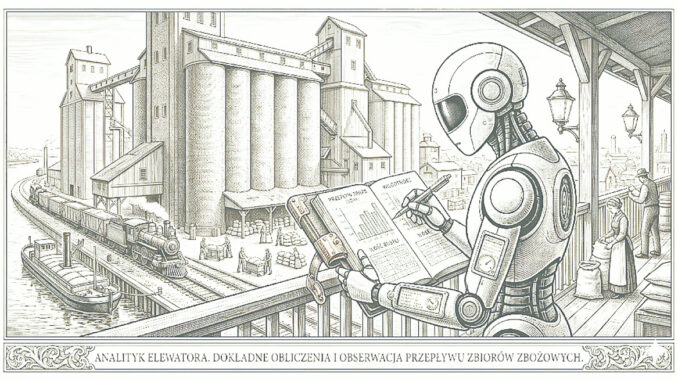
Do You Still Need an Office Employee? Imagine That You Hire a Ghost
A ghost is invisible. You do not hear the clatter of keys. It is not at the coffee machine at nine o’clock. It does not arrive late on Monday with a story about traffic jams. It simply works. On your computer, in your folders, in your emails, in your documents. You look at the monitor and see the mouse flying across the screen. On its own. It opens a folder. It goes into the documents. It reads reports. The window has closed. A new one has opened. It writes a reply to an email from a flour customer. Closes it. Opens the browser. Goes to the grain exchange website. Checks wheat quotations. Closes it. Opens Excel. Fills in a table with raw-material prices from the last week. Generates a chart. Pastes it into the report. Sends the report to the owner.
This entire spectacle takes perhaps forty minutes. A normal office employee would do the same thing for half a day. With breaks for coffee, for a conversation with a colleague from the department, with the moment when they lost a file and looked for it for a quarter of an hour before it turned out that they had saved it under a different name in a different folder.
This is not science fiction. It works. Right now. And in a moment I will show you exactly how.
Office employee: what do they actually do?
Before I accuse anyone of being unnecessary, let us honestly name what we are talking about.
An office employee in a mill or a grain-trading company does specific things. They receive invoices. Issue documents. Arrange meetings with suppliers and customers. Send emails requesting quotations. Answer telephone calls. Prepare sales reports at the end of the week. Analyze complaints. Keep track of delivery deadlines. Monitor purchasing prices. Write summaries for the owner. Sort documentation. Remind people about overdue matters. Check whether all orders have been completed. Go to industry portals and check what has changed.
This is honest work. Necessary work. But it is not work that requires a human. It requires attentiveness, systematicity and the ability to work with information. And AI does precisely these three things better than a human. Not faster. Better. Because it does not lose concentration. It does not lose context. It does not skip a row in a table because it happened to be thinking about something else.
The ghost in your computer. How does it work?
A few days ago, OpenAI released a new version of its model. GPT 5.5. More expensive than its predecessor. Twice as expensive. But it is not the price that I want to talk about here.
I want to talk about a function called Computer Use. In Polish: using a computer.
This is not a chatbot that answers questions. It is something else. This system opens applications. Clicks menus. Drags icons. Reads files. Fills in forms. Logs into programs. Goes to websites and downloads data from them. It does exactly what you do with a mouse and keyboard. Except that it does it non-stop, without a break and without an error resulting from distraction.
The demo shown by OpenAI engineers looks simple. They give it an instruction: build me a note-taking application with columns. The application is created. And then—and this is the moment that makes you stop—the system launches that application itself. It enters it as a user itself. It adds test cards itself. It moves them between columns itself. It checks whether everything works itself. Without human involvement. It creates, tests and reports the result by itself.
Watching this is like watching a time-lapse film of someone’s work. Except that this someone never takes a break. This someone is invisible; the chair is empty.
How does this relate to a mill and grain purchasing?
Now for specifics. Because I know that you did not come here to read about technology for technology’s sake.
You have a mill. Or a purchasing point. Or a company trading in flour, wheat and rye. Every day, invoices come in from suppliers. Emails arrive with questions about prices. You need to check whether yesterday’s delivery was complete. You need to check wheat quotations because a contract ends in a week and a decision has to be made. You need to prepare a report for the accountant. You need to reply to three requests for quotations. You need to arrange a meeting with a new packaging supplier.
This is a full-time office job.
AI can do it. Not everything immediately, not overnight, not without any preparation. But it can. And it can do it around the clock, seven days a week, for a fraction of the cost of a full-time position.
How much does it cost? Honest mathematics
Here a word appears that blocks half of the conversations about AI in small and medium-sized companies: token. A token is a billing unit. Roughly one to four words are one token. AI models are billed per million tokens. And this is where there is a spread that makes a difference.
The cheapest models cost a few cents per million tokens. Such models are sufficient for simple tasks. Reading emails, extracting key information from them, replying according to a template, sorting documents, filling in tables. This is work that a secretary would do. And for this you do not need the smartest model on the market. You need one that is cheap, efficient and well configured.
More expensive models, such as GPT 5.5 or Claude Opus, cost several dollars per million input tokens and more than ten dollars per million output tokens. These are for tasks requiring analysis, synthesis, comparison of many documents and drawing conclusions from long reports. For the owner of a mill who wants to receive a summary of the week every Friday: how much was sold, where there were complaints, what changed in raw-material prices.
For comparison. A full-time office employee costs several thousand zlotys a month. ZUS contributions, holidays, sick leave, severance pay, training. On top of that, the onboarding time and the time taken by mistakes in the first months. AI costs as much as the tokens it uses. With the normal office work of one person in a medium-sized mill, we are talking about several dozen zlotys per month. Perhaps several hundred with very intensive use of expensive models. Rarely more.
Yes. You are reading this correctly. Several dozen zlotys per month versus several thousand.
But there is a catch. And a serious one
There is no room for pretence here. There are barriers and they need to be named.
The first barrier is the horizon. A normal entrepreneur, even one who follows new developments and is open to change, will not entrust their documents and correspondence to a machine they cannot see and do not understand. This is an honest reaction. Commercial data are no joke. Data about purchasing prices, contracts and margins are sensitive information. Letting something you do not understand into this is a risk. And this fear is rational.
The second barrier is configuration. AI does not come out of the box ready to work in your company. You have to tell it what to do. How to react to specific emails. Where to save the results. Which systems to connect to. How to treat invoices and how to treat offers. How to generate a report so that it is readable for the owner, not for a data engineer. This requires work. Not necessarily a lot. But it requires someone who can handle it. And here a concept appears that will become increasingly popular over the next two years: AI engineer.
Who are they and why are they as rare as snow in May?
An AI engineer is not a programmer. At least they do not have to be. It is someone who understands how language models work. Knows how to write instructions for them. Knows how to configure them for a specific task. Knows which tasks require an expensive model and which a cheap model will perform equally well. And, most importantly, understands how a company works. Not an abstract company from a management textbook, but a specific one that has thirty suppliers, three sales outlets and has had a problem with complaints from one retail chain for a month.
This combination of qualities—an understanding of AI plus an understanding of the industry—is rare on the market. Truly. Like someone who can both repair a combine harvester and make an Excel presentation for a bank. Such a person exists, but you have to find them.
One such person can supervise several or a dozen or so AI assistants operating simultaneously in several companies. This is a new model of work that is slowly taking shape. You do not employ an assistant full-time. You employ an AI engineer who configures assistants for you, makes sure they work, corrects them if they start making mistakes and expands them if the company grows.
You share the cost of this engineer with other companies. Because one person can handle a dozen or so such assistants.
What does AI do worse than a human?
It will not call a difficult customer and persuade them to change the terms of a contract. A human can. AI cannot. It will not notice that a supplier has recently been strangely late and may be having financial problems if no one tells it. AI reads data; it does not sense the mood of a conversation.
It will not go out into the production hall and see that something is wrong with a batch of flour before a complaint appears. AI is digital. The production hall is physical.
It will not replace a salesperson at an industry trade fair. It will not shake hands. It will not build a relationship over lunch. It will not make a decision whose consequences cannot be calculated. A human often does not make such decisions well either, but at least takes responsibility for them.
And what does it do better?
Weekly report. Instead of an office employee taking three hours, AI takes twenty minutes. Data from the sales system, a comparison with the previous week, anomalies highlighted, a finished document. In the owner’s inbox in the morning.
Email handling of enquiries. AI reads incoming emails. It answers questions about prices according to the current price list. It classifies complaints and forwards them. It collects proposals for cooperation in one place with a short summary. What required the attention of a full-time employee is reduced to a few decisions by the owner each day.
Monitoring purchasing prices and quotations. AI goes to industry portals. Downloads data. Compares them with data from the previous week. Flags changes above a threshold that you set. Sends an alert. You do not have to browse websites every day. You receive a signal when something changes.
Order documentation. An order arrives by email. AI reads it. Checks whether it falls within the current offer. Creates an order document. Enters it in the register. Sends confirmation. Everything without human involvement.
Invoices. AI receives an invoice by email. Reads it. Checks whether it matches the order. If it does, it forwards it for approval. If it does not, it flags the discrepancy. The owner sees only exceptions, not routine.
GPT 5.5 versus previous versions. What has changed?
There is one change in the new model that has practical significance for such an application.
Previous models lost sight of the goal after several dozen minutes of work. You gave it a task for an hour, and after forty minutes it was already writing about something completely different. Like an employee who started with a sales report, got drawn into checking emails along the way, and at the end of the day had done half of one and none of the other.
The new model does not do this. It sticks to the task. To the end. This sounds trivial until you start assigning it tasks that take longer than a quarter of an hour. Then it turns out that this is the key difference.
The second change is documents. GPT 5.5 produces better reports, better summaries, better presentations. Not at an expert level. At the level of a solid junior employee. For the owner of a bakery who needs a weekly summary for themselves and their business partner, this is entirely sufficient.
Where can you get such a tool? An honest review of the options
Option one: do it yourself. You register an account with OpenAI or Anthropic. You pay for the API. Configure. Test. If you like experimenting with technology, this is a good path. If not, it is a path to frustration after two weeks.
Option two: hire someone to configure it. A one-off job. You receive a ready-made tool. You pay once, then only for tokens. This is a sensible option for companies that know what they want but have neither the time nor the inclination to experiment.
Option three: outsource an AI engineer. You pay someone monthly to supervise assistants in several companies simultaneously. More expensive than option two, but you have someone who reacts if something stops working. A good option for companies where the assistant’s work is critical.
Option four: wait. That is also an option. The technology is maturing quickly. In a year it will be easier to use, cheaper and more accessible. The cost of waiting is the amount you overpaid during that year for work that AI could have done more cheaply.
A small note for the sceptic I can see here
I understand the scepticism. Really. Over the last twenty years, various technologies were supposed to revolutionize companies. Some did revolutionize them. Some ended up in a folder with leaflets from industry trade fairs from 2008.
AI is not in the same category as those promises. And I will tell you why, specifically.
Firstly—it already works. Not in a beta version, not in a pilot version for large corporations. It works for small companies that have someone who configured and launched it. It works in Poland, now, for a normal fee.
Secondly—the costs are calculable. There is no model here in which you pay for a subscription for a year and hope that it will pay for itself in three years. You pay for tokens. You know how much you used. You know how much you paid. You can calculate whether it pays off within one month of testing.
Thirdly—the entry risk is low. It does not require changing systems, a major integration or a months-long implementation. You can start with one task. For example, a weekly report. Check whether it comes out well. Then expand.
Office employee. Quo vadis?
This is not an article saying that all office employees will lose their jobs in a year. That would be a dishonest simplification, and anyone who says so either does not understand the labour market or is trying to frighten you with something.
This is an article about the fact that some of what an office employee does is ceasing to require a human. And that part will grow. Not in leaps, but systematically, year after year.
Reports, sorting, emails, documentation, data monitoring, filling in tables, checking deadlines, creating summaries. All of this is migrating towards AI. Quickly.
What remains for humans is relationships, negotiations, decisions under uncertainty, physical presence, breaking deadlocks, representing the company. These are things that a human does better than a machine and will continue to do better for a long time.
A company that understands this can prepare itself. Not through redundancies, but by changing what it uses its people for. An employee who today prepares reports for four hours a day may tomorrow spend those four hours talking to customers because AI prepares the report. This is not a degradation of work. It is a change in the structure of work.
Finally, one question
Your cheapest office employee costs, let us say, four thousand zlotys net per month. On top of that, ZUS contributions, holiday, a possible replacement, training. The real amount on the company’s side is six or seven thousand zlotys per month. AI will do half of their work for several dozen to several hundred zlotys per month.
The question is not: can you afford AI? It is: how much longer do you want to pay extra because you do not have AI?
This is an honest question. For a company with one sales outlet, the answer may be: I will wait another year. For a company trading grain, with several dozen contracts per month and daily price monitoring, the answer is different.
The ghost in the computer does not ask for a pay rise. It does not take a holiday during the season. It does not arrive late on Monday. And it does not steal your time with explanations of why the report is ready on Wednesday instead of Monday.
You may not like it. But you can hire it.
Wojciech Moszczyński
Wojciech Moszczyński—a graduate of the Department of Econometrics and Statistics at Nicolaus Copernicus University in Toruń; a specialist in econometrics, finance, data science and management accounting. He specializes in the optimization of production and logistics processes. He conducts research in the area of the development and application of artificial intelligence. For years, he has been involved in popularizing machine learning and data science in business environments.