
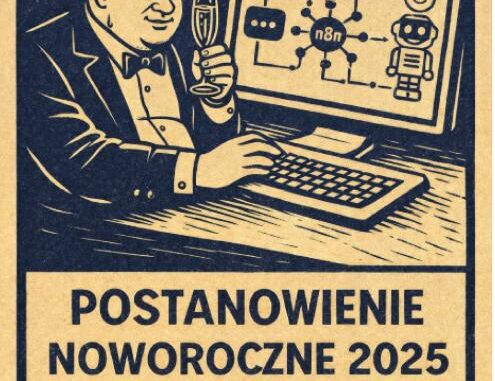
n8n, or Automation Instead of Losing Weight in the New Year
Let us begin the New Year with new challenges. What challenges might appear in the column I run? Obviously: introducing artificial intelligence. I have been writing about it in the pages of Przegląd for at least ten years, and I strongly encourage readers to treat 2026 as the year of artificial intelligence.
I generally suspect that such an appeal may irritate many readers. How exactly are we supposed to “introduce artificial intelligence”? What artificial intelligence? And what is all this about? There is one great commotion, among acquaintances and in the professional world, that “we must”, that “we have it”, that it is essential, that it is a requirement for being modern, that it is something obvious in a world dominated by AI.
Artificial intelligence—do you really have to?
So I hasten to report: most people reading this text introduced artificial intelligence into their lives long ago. We have it in our phones: improvements connected with taking photographs, organizing time, searching, navigation and so forth. But to introduce artificial intelligence into our bakeries, confectioneries and sales networks, we must make a little more effort. Of course, many suppliers already offer modern solutions: working-time organizers, shift planning, production planning and sales forecasting in bakery-product distribution networks.
Except these applications are often ordinary, very simple computer programs connected to artificial intelligence. By “artificial intelligence”, I mean supercomputing centres in which one of several thousand language models commonly called artificial intelligence “resides”. These are models such as ChatGPT, Gemini, DeepSeek and Claude. Writing such an application can be childishly simple: it is enough to write a Python program that performs some task. But the application’s entire brain is coupled to a computing centre. And that centre charges for so-called tokens—that is, one must pay to use machine thinking, just as we pay a subscription for electricity.
No one now produces software containing its own “intelligence”, understood as something truly advanced. The newest solutions are connected to superintelligent language models. Thus, if someone offers you “a very intelligent organizer” that plans an advertising campaign and organizes transport logistics, in practice this often means a small, easily written program connected to a language model. Much of the monthly instalment paid for using the solution is then passed on as a subscription for using one of those powerful models.
We cannot program—so what are you going to do to us?
Continuing this line of thought: why can we—bakers and confectioners—not write such a little program ourselves, connect it to artificial intelligence and pay the subscription directly?
The answer is striking in its simplicity: because we cannot program and do not know how to organize software. Such things are done by specialists who have created similar solutions for many years and are often simply impossible to surpass. Their abilities—at least when seen from the outside—look like magic, and their skill in writing code can be fascinating. Some people suspect them of contact with an extraterrestrial civilization.
And now, take note: programming abilities are genuinely difficult to acquire, learn and exercise actively. Writing code can be sad and difficult, and it is easy to make mistakes. But everything changed during the last two years. The introduction of thousands of language models changed programmers’ entire lives. Language models now write code for people. In other words, it is enough to say what we want a program to do and a language model can write the entire piece of software.
Unfortunately, this is not yet a perfect system. Firstly, one must know how to write a project—that is, a query or prompt—for a language model. Secondly, the model rarely provides an ideal solution, and its work must be corrected dozens of times with successive prompts. Yet this is undoubtedly no longer a situation in which a person alone in the wilderness of digital space must create something from nothing, code it and test their own solutions. Today, a large part of that work is performed by a machine: a language model, one of hundreds of thousands—and sometimes even millions—of available variants.
If I had read what I have just written two years ago, I would have thought someone had consumed too much alcohol or developed some kind of mental illness. Had I read it a year ago, I would have concluded that society contained visionaries with sufficient imagination to predict the future. Today, this text is simply obvious in the professional circles of IT and data-science experts.
If we therefore assume that we no longer need to write code perfectly in order to create our own artificial-intelligence solutions, and that some organizational sense and the ability to work effectively with a model are sufficient, we begin approaching areas in which we can act ourselves.
Except that we must still know a little code, correct the machine a little, test it a little, understand what is going on, and so forth. In summary: even when using LLMs, we are often unable to introduce artificial-intelligence solutions into our own work—our bakery or confectionery—from scratch in a manner that is stable, safe and works every day.
So we are not a professional folk-art curiosity
It is worth emphasizing here: it is not the case that we are backward and should be ashamed. Nor is it the case that we “should already have” an artificial-intelligence system monitoring oven temperatures, controlling correspondence, simultaneously checking vehicle locations and analysing sales—doing everything artificial intelligence supposedly “should do”.
We are not backward. We are living in market realities. Not knowing artificial intelligence or coding is not our weakness—it is normal. Thorough knowledge of these areas is time-consuming, requires great sacrifice and must be constantly updated. On the other hand, implementing such solutions through an external company involves high costs and does not guarantee success. Why? Because implementation companies are also made of people, and people are scarce in the market. Most are beginner, unseasoned artificial-intelligence “experts”. To summarize: even the most reputable company consists of people, and people are in short supply—leading to the conclusion that we should introduce artificial intelligence as independently as possible, at least in part.
No pressure—here comes n8n
Before you throw away this article—which would obviously be a sign of self-preservation—learn that you are not the only one reaching such conclusions. People generally do not implement artificial intelligence in their companies because they see barriers connected with coding and “knowledge of code organization”. Amid the pressure of their own work, they therefore prefer to commission someone else. And because others also have problems finding suitable specialists, companies remain stuck with twentieth-century solutions. Owners are often ashamed of their shortcomings and tend not to advertise the fact that they are still unable to implement anything from modern technologies.
Here an interesting thread appears. A company from Berlin reached similar conclusions and created a tool intended to permit effective artificial intelligence to be implemented without knowledge of code and even without any particular knowledge of the IT environment. This tool is called n8n.
Let us pause for a moment, because n8n is not “another planning program”, but a certain way of thinking about work. n8n is a workflow-automation platform in which process logic is built as a graph of connected nodes triggered by events. This sounds threatening, but it concerns simple things: something happens—someone sends an email, a new document appears, an order arrives, someone completes a form—and the system reacts and launches the next steps.
The tool combines integrations with external services, data processing and programmable elements, offering a compromise between a no-code approach and conventional coding. In other words, you can click and arrange things, but if you wish, you can go deeper, add your own logic, correct something or calculate something. This matters because in real life companies do not operate like catalogue examples in a presentation. There is always an exception, “our situation”, or some specificity of the plant. n8n is developed by n8n GmbH, based in Berlin, and is available both as a cloud service and for self-hosting. You can have it “at their place” or “on your own computer”, in your own environment, if you value control and independence.
Why did this class of tools arise at all? Modern IT systems consist of many services at once: SaaS applications, databases, event queues, file repositories, analytical tools and AI models. Their integration is often performed ad hoc: someone writes a script, someone configures cron, someone adds a webhook and somehow it works—until it stops working, after which no one knows where the error is, why it stopped or who is responsible. This leads to growing maintenance costs, poor observability, and difficulty versioning and auditing processes. Workflow automation enters here: modelling a process as an explicit control-and-data flow launched in response to events. It is like writing work out on a sheet of paper, except that the sheet is “alive” and performs the work.
The core of n8n is a workflow editor in which a graph is arranged from nodes serving as triggers, integration steps such as receiving or sending data to a service, data transformations, conditions and flow control, and error handling and retries. Workflows run in the n8n server environment, while integrations are performed through ready-made connectors—of which there are many—and generic HTTP mechanisms; in short, “if there is no ready-made block, it is still possible to communicate with the internet”.
In practice, n8n acts as an orchestration layer. Instead of implementing complete processes in one huge program, you describe the sequence of steps, field mappings and transition conditions. You obtain clarity, easier diagnosis, the ability to reuse fragments and faster prototyping. Documentation and the community also strongly promote combining automation with AI components, which matters today because people do not only want to “automate”; they want to “automate intelligently” and still know a month later what they did.
Is n8n “for people who cannot program”? Yes and no. It is a low-code tool: basic workflows can be built without writing code, through configuring nodes and mapping data in the interface. But “no code” does not mean “no technical thinking”. Effective use usually requires an understanding of HTTP, OAuth—that is, signing in to services—data models such as JSON, error semantics, API limits and elementary reliability engineering, so that it works not only on Monday morning but also on Friday evening. In simple scenarios, it is accessible to non-technical people, but its greatest advantage appears when someone can consciously design integrations and control automation quality. This is an honest description: n8n does not perform miracles without a person, but it removes 80% of the pain and financial cost that was previously impossible to overcome.
There is also the subject of the manufacturer and distribution model, because I hear the questions “is it open source?”, “is it free?” and “will someone trap me in a subscription?”. The manufacturer is n8n GmbH. The project is developed publicly and its code is available, while the licensing model is described as fair-code under the Sustainable Use License. In practice, this means it may be used and modified, and one may build one’s own processes with it, but there are restrictions such as “do not build a competing one-to-one service and sell it as your own n8n”. It is therefore not “classic open source in the OSI sense”, but neither is it a black box that cannot be touched. For an ordinary company that wants to automate its own work, this is generally sufficiently simple and understandable.
The company decided to bring to market a product that enables practically everyone to create advanced automation systems—such “actively operating artificial-intelligence systems”. Every business has its own needs, and I will not pretend that I can immediately devise the ideal catalogue of bakery uses. I can only cite examples from the internet: people say n8n allowed them to organize meetings, filter online events, select the most likely subjects for discussion and automate information analysis. Advanced matters, presented simply.
I will come to the substance and show several screenshots shortly, but I will say this from my own perspective: I am still stuck in technologies from a year or two ago. My artificial-intelligence implementations are based on Python. What is new in my work is that I use several language models at once, because models differ: some are better at distinguishing particular things, others are more analytical and still others are simply cheaper. This week I wrote a solution containing, by a conservative estimate, approximately 400 lines of Python code.
So I asked artificial intelligence to transfer this working solution into n8n. It turned out that my “complex” solution consisted of just five squares arranged as a diagram. Practically anyone can create each square: simply click with the mouse and select the type of element. For example, the first square starts the process, the second contacts an LLM, the third records the result, the fourth sends it to an inbox, and the fifth handles an error or performs logging. Every “box” in the diagram must be completed; it contains forms, but completing them can be childishly simple: in one place we tell the model what to do, and in another we write “pass the input value onwards”.
And now the most important point: anyone with minimal technical knowledge—by which I mean someone who knows how an oven for baking rolls works, or understands how a car clutch is used—can quickly learn to “program” these squares. They are called nodes. They contain instructions: we can write them ourselves, or artificial intelligence—even the one in our phones today—can write them for us. If someone already knows Python and has application experience, I will say directly that this is a complementary tool. Python remains for heavy tasks, calculations, ETL, ML models and API services, while n8n serves as the “glue” layer that connects systems, sends, receives, orchestrates and monitors flows. This is exactly the part of the work no one likes doing manually and that can consume weeks.
Implementation is simple: the diagram is launched, and one can clearly see how information flows, how the language model “thinks” and what happens in sequence. It is somewhat like building technical solutions from LEGO blocks. Of course, no one off the street will build a complicated machine immediately—one must learn a little and understand the principles. But this time, implementing artificial intelligence in a production plant ceases to be an abstraction and becomes a real prospect.
Importantly, n8n in its basic version is free, and costs generally arise when a solution operates intensively, continuously and is genuinely used in a company. I have extensive experience creating such things, and I will say honestly: it is not “completely simple”. One must learn to think a little differently from conventional programming. Building vehicles from LEGO is not entirely obvious either, but it is fun—and it can be similar here.
Those who build automations professionally and use n8n often say that the best start looks like this: artificial intelligence builds an initial diagram for them, they download the ready-made definition from the screen—a file in JSON format, sometimes jokingly called “jay-son”—paste it into a text file and import it into n8n. These actions are easier than installing an application on a phone. They then launch the solution and begin correcting, improving and tuning it. They begin from a different level: not from a blank page, but from a prototype that almost works.
No more New Year’s weight loss?
The quality of work in implementing artificial intelligence has changed radically over the last year. Many things have now become easier. The entry level has fallen to something resembling building machines from blocks: it can be done without many years of coding practice. If “a new year and new challenges” exists anywhere in all this, it is here—in not being afraid of tools that permit a calm, step-by-step entry into automation and AI. Why become stressed and tense?
A simple resolution is enough: I have free n8n and want to introduce automation for controlling the oven—only temperature control. That is my objective. I give myself 40 days; every day, for an hour instead of watching short videos on my phone, I will take minimal steps towards achieving it. Our four-week model may consist of two connected blocks. What matters is that it works and does the job. This is exactly as much time as I would normally devote to building an electric vehicle from LEGO blocks. If the task succeeds, further expansion of automation will be straightforward. It is only that much—and as much as that.
Perhaps the greatest paradox is that for years we thought artificial intelligence would be “a system costing millions”, a six-month implementation, consultants, slides, audits and “we will return to the subject after the holidays”. Yet real artificial intelligence in a company—the everyday kind—comes down to whether we can connect several steps into a sensible process and keep it running. This is what n8n is about: making the process visible, understandable and correctable and—crucially—ensuring that it does not depend on one person with “secret knowledge”, but on something displayed on the screen and operating like an electrical diagram. In my mind, this is the difference between an abstraction and a real implementation. That is why I believe 2026 is a good time to stop lurking over “whether” and begin doing something with it.
Wojciech Moszczyński
Wojciech Moszczyński—a graduate of the Department of Econometrics and Statistics at Nicolaus Copernicus University in Toruń; a specialist in econometrics, finance, data science and management accounting. He specializes in optimizing production and logistics processes. He conducts research into the development and application of artificial intelligence. For years, he has been involved in popularizing machine learning and data science in business environments.