
Kanban: A Process Management Method
Przegląd Zbożowo-Młynarski 6/2022
Have you never wondered why everyone in the office runs around one another, everyone doing something, writing and making calls, while matters remain at a standstill, projects do not move forward and, at the same time, new matters keep appearing? When you devote a little more time to observing this, you will notice that employees often take on further tasks without closing the previous ones. When work on one task becomes burdensome or blocked, they seize upon other topics. After all, you pay them to work. Do you pay them for ineffective work? How can this ineffective working model be changed? Kanban is the remedy!
In the 1940s, somewhere in Japan, a busy Toyota workshop manager, engineer Taiichi Ono, decided to go shopping. He entered a supermarket and saw that there were no goods lying around on the floors and no queues at the shop shelves. He noticed that when goods disappeared from a shelf, new goods appeared immediately. This extraordinary experience changed the young engineer’s life.
I do not know how much truth there is in this naive story. Toyota likes to mythologise its solutions. Toyota presents the origins of its other solutions—just-in-time and TQM—in a similarly fairy-tale manner. There is no doubt, however, that the assumptions of Kanban are very close to the organisation of a well-managed supermarket.
At the time when engineer Taiichi Ono was trying to improve the efficiency of his department, there was general carelessness regarding the circulation of spare parts, components, work in progress and the general approach to completing tasks on time. The entire mechanical department he managed was strewn with boxes containing semi-finished products and parts that required further processing. One of the greater problems in production, both then and today, is machine changeover. This costly operation is carried out whenever the product range changes. The number of production changeovers therefore depends on the number of products being produced. The more open tasks there are in the process, the greater the need for production changeovers. A large number of changeovers is associated with the probable need to expend labour resources—largely unnecessarily—and with a loss of time and money.
Taiichi Ono, with the economy of movement typical of Japanese samurai, cut through all this disorder by introducing Kanban, a Japanese set of work-organisation principles. I do not wish to imagine what these principles sound like in Japanese, but even in Polish they are very unambiguous:
- no shortages,
- no delays,
- no inventories,
- no queues—anywhere or for anything,
- no idleness,
- no unnecessary technological or inspection operations,
- no movements.
This peremptory set of principles was not addressed directly to Japanese workers, because that would have caused unnecessary stress and would probably have worsened an already poor situation overall. In fact, the workshop employees might not even have known that these postulates existed. Human-resource management is never about intimidating people or creating an atmosphere of terror. These postulates are guidelines on how work should be organised and were addressed exclusively to managers responsible for production processes.
WIP and Little’s law
The name WIP comes from the expression “Work In Progress” and hardly requires any comment. To prevent a pile of unfinished projects from accumulating in the office or factory, their number must be limited.
Anyone who wants to start a new process must be able to point to the completion of another process. The phenomenon of escaping to other projects without finishing current matters must be prevented. This solution avoids the trap of accumulating unfinished tasks.
Individual tasks can become blocked for various reasons. For example, an article in an editorial office cannot move forward without the editor-in-chief’s approval, while the editor happens to be on sick leave. We cannot finish installing a furnace because missing parts are on their way. If the team cannot finish installing the furnace, it should undertake other work.
Is one of the Kanban principles not the postulate of “no idleness”? Because of the WIP limit, however, employees cannot begin installing another furnace before completing the current project. The WIP-limit recommendation appears more like a method of reducing productivity than increasing it. The foundation of Kanban is balancing the process.
Kanban is not an instrument of terror but a method of organising work. Work must be organised so that there are no stoppages. Work is organised and planned before it begins. A furnace cannot be installed if we do not have a complete set of parts. Once begun, work must be completed. If an unexpected cause of obstruction appears, everything must be analysed and conclusions drawn so that it does not happen in the future. When a process stops, another new project must not be launched.
The objective of this approach is constant process throughput, achieved mainly by eliminating bottlenecks and anticipating apparently unpredictable barriers. Process efficiency in Kanban is measured using cycle time, known as Little’s law. Cycle time is the number of WIP orders divided by the total order-completion time. This gives us the average number of orders per unit of time. When a limit is imposed on open orders, the organisation automatically improves the efficiency of work on orders.
Why is multitasking bad?
It is impossible to do several things at once. Every team member needs a moment to begin each successive task. The lack of proper concentration on a single task caused by multitasking increases the number of errors and forces people to recall the details of orders. Studies concerning Kanban implementations state that merely switching between tasks consumes 10% of the task-completion time. Added to this are the correction of errors and the act of remembering what the task was about. The various losses of time resulting from multitasking add up to great losses that can no longer be recovered.
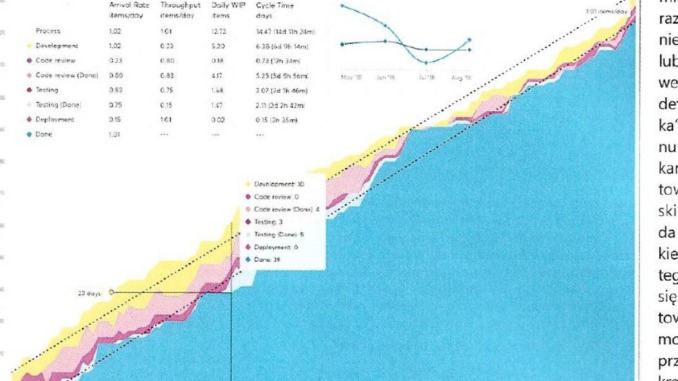
Cumulative flow diagram for tracking work in progress
The principal method that makes it possible to implement the restrictive Kanban principles listed at the beginning of this article is the elimination of bottlenecks. A very specific cumulative flow diagram is used for this purpose. An example flow diagram is presented in the original article. The horizontal axis represents the passage of time; the vertical axis describes how many operations have been performed—for example, how many items have been produced, projects carried out or help-desk tickets closed. The coloured areas—yellow, pink, purple and blue—represent stages in the completion of individual tasks. The primary concern in this diagram is maintaining process stability. The completion time for successive items, orders or requests does not change. The coloured areas do not move outside the corridor defined by the two dotted lines.
Delivery management
For the ambitious Kanban principles to be implemented, orders for current assets must be fulfilled appropriately. There can be no queues, shortages, delays or inventories, and no unnecessary movements. There must be exactly the right quantity of goods on supermarket shelves. No one may wait for goods or for another batch of semi-finished products for further processing.
When goods disappear from a shelf or when the spare-parts container becomes empty, demand for another batch of goods or components must be reported immediately. In the orthodox version of Kanban, after components disappear, a “card” is sent to the warehouse; the goods arrive from the warehouse with the same card, receipt of which must be acknowledged. In Japanese, Kanban means “card”. The card method in Kanban was once the system’s leading operating idea. Today, methods are used to manage the rotation of goods by continuously monitoring them in a database with barcode readers.
Of course, the replenishment process cannot be launched only when a box is empty. Under this method, lower control limits must be adopted for inventory levels. If the waiting time for deliveries is long, the limit should be correspondingly higher.
Summary
Kanban is a radical method that sets itself postulates which appear impossible to fulfil. Consistently striving to implement these postulates forces the introduction of tools and methods that bring the organisation closer to its objective. A company that succeeds in eliminating unnecessary queues, downtime and blockages in project execution will achieve great savings, which can constitute a competitive advantage that is especially necessary in the uncertain times ahead.
Wojciech Moszczyński — expert in mathematical optimisation and predictive modelling. For years, he has been involved in popularising econometric methods in business. He specialises in optimising sales, production and logistics processes. For 15 years he worked as a financial expert specialising in controlling and management accounting. For 10 years he has worked as a data analyst (data scientist). He is a graduate of the Department of Econometrics and Statistics at Nicolaus Copernicus University in Toruń. He is currently employed as a Senior Data Scientist at the Polish company Unity Group.