
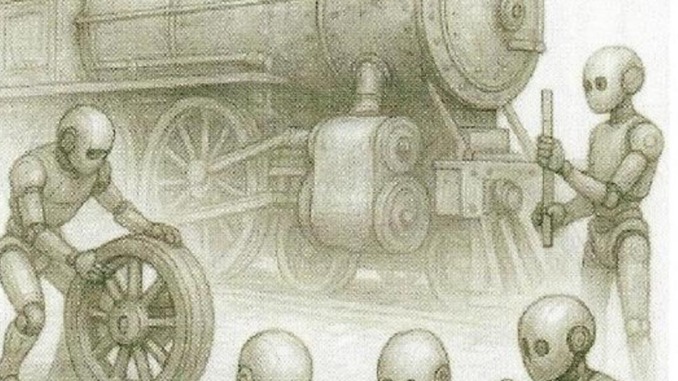
Imagine that we are living at the beginning of the nineteenth century, just after the fall of Napoleon Bonaparte. Everything around us is a natural economy based on small manufacturing workshops and age-old trades such as blacksmith, carpenter, roofer, and wheelwright. Certain standards exist in individual industries, but no one yet draws detailed designs or creates complex devices built through the cooperation of many companies.
Suddenly, a groundbreaking invention appears—the steam locomotive. This device is extraordinarily complex and requires the work of outstanding specialists; the vehicle is created through cooperation among carpenters, metallurgists, engineers specializing in coal combustion, and logistics experts. Strict standards appear, such as track gauge and the vehicle’s maximum weight. The machine is designed by engineers and built on the basis of complicated technical drawings. New steamships, iron bridges, and frame buildings are created in a similar way. We call this period the technological revolution.
I have cited this example to make it clear that, at first, only some industries used the newest forms of organization, such as standardization, the preparation of designs and technical drawings, and interdisciplinary teamwork. In other fields, such as furniture production or house construction, everything was still done “by eye,” without technical documentation, designs, or standardization. The situation gradually changed, and today it is difficult to imagine even the simplest object or device being made without documentation, designs, and a planned production process. At the beginning of the industrial era, a high standard of manufacturing and production planning was applied only where it was absolutely necessary. A steam turbine cannot be built “by eye,” nor can such a complex mechanism be produced without highly educated experts from various fields.
Changes, Changes
Everything groundbreaking changes the surrounding reality. The invention of the jet engine brought about a complete change in the way aircraft were designed—the need arose to test and analyze the phenomenon of material fatigue. The arrival of computers, in turn, completely transformed the way people worked. For a time, people tried to produce software by applying patterns known from other industries, such as the textile and machinery industries. Teams were formed, designs were developed, and efforts were made to optimize the software design process. It very quickly became clear, however, that the existing patterns borrowed from other fields did not work at all in the IT industry. Software development teams were ineffective and therefore increasingly frustrated and discouraged from creative work.
They Thought—and Came Up with a Solution
Just as during the Industrial Revolution, two hundred years later the IT industry—which for years had operated in a spirit of craftsmanlike freedom and “working by eye”—finally had to confront a wall of inefficiency and chaos. In the IT world, which even at the end of the twentieth century resembled a carpenter’s workshop more than a large factory, every project was created according to its own rules, often without in-depth planning, standardization, or a methodical approach. Programmers, like the craftsmen of old, wrote code in their own way, and the results of this work often resembled houses built without a technical drawing: sometimes something solid was created, while at other times everything fell apart.
Change came when the IT industry began to face challenges comparable to building the first steam locomotives or iron bridges—complex, costly undertakings requiring close cooperation and constant responses to change. It was then, at the turn of the century, that the idea began to germinate among programmers that the existing project-management methods, modeled on rigid industrial schemes, were simply insufficient. Attempts were made to introduce rigid methodologies straight from factories or design offices, requiring long plans, extensive documentation, and precise specifications, but the virtual world proved too dynamic to submit to these rules without a loss of efficiency, motivation, and the teams’ creative spirit.
Just as the Industrial Revolution forced the birth of new standards, the IT world had to create its own foundations in order to meet increasingly complex challenges. February 2001 proved to be the breakthrough. At that time, seventeen outstanding experts from the IT industry deliberately chose the Snowbird ski resort in the US state of Utah in order—away from everyday life and amid the silence of winter—to consider what a modern way of working on software should look like. Like the pioneers of technology in earlier times, these were people who already had their own, often painful, experiences of attempts to introduce and work within ossified structures. They knew that continuing along this path led nowhere.
In an atmosphere of openness and intellectual freedom that was impossible within the rigid walls of corporate offices, a document was created that went down in history as the Agile Manifesto. Just as technical drawings and standards served railway builders, the Agile Manifesto became a new point of reference for software developers. Instead of putting procedures, tools, and documentation first, it gave priority to people, cooperation, rapid responses to change, and the delivery of a working product—just as, during the Industrial Revolution, combining different competencies, flexibility, and adaptation to changing reality became paramount.
Why did this manifesto have to be created in precisely that place and at precisely that time? Just as it was no longer possible to build steam locomotives “by eye,” it was no longer possible to develop software according to twentieth-century, Cold War-era standards. The industry had matured enough to define new values clearly, develop common principles, and create something resembling a code—a foundation on which projects meeting contemporary needs would be built over the following decades. The ski resort where the IT leaders met was therefore a symbolic place for breaking with routine and an attempt to view the industry from a distance, just as engineers once had to rise above old craft habits in order to design bridges, locomotives, and skyscrapers.
The Agile Manifesto was therefore not merely the outcome of a meeting of several IT executives. It was a response to a profound need for change that had been smoldering throughout the industry. It expressed rebellion against outdated working methods and, at the same time, extended an invitation to build the future in a spirit of trust, cooperation, and continuous improvement. In this way, just as the technological revolution once transformed the landscape of Europe, the Agile Manifesto permanently changed the world of information technology, turning programmers into modern architects of digital reality.
The Spread of New Ideas
At the beginning of the industrial era, only selected sectors of advanced technical production developed specific forms of work organization and their own operational culture. Other branches of industry continued to operate within the order inherited from the era of bourgeois France, in which manufacturing was based on traditional recipes, methods, and technologies passed down from generation to generation.
An analogous situation can be observed two hundred years later. Only some industries began to implement an innovative approach to work organization based on the principles formulated in the Agile Manifesto. Other sectors remained with conventional management models, reluctant to change their existing structures and practices.
Over time, the principles characteristic of the Agile approach began to permeate other industries. Similar rules—flexibility, rapid responses to change, and customer orientation—also began to apply in other branches of industry.
For example, until recently, the clothing industry focused on producing large, uniform batches. With the development of design and consumer expectations, a need arose to create short, diverse, and highly individualized product series. The automotive industry underwent a similar evolution. In the past, a single car model could be produced for a dozen or even several dozen years, as in the case of the Volkswagen Beetle. Today, different models are produced in parallel at Volkswagen factories, often in small series tailored to specific orders and differing in equipment details and configuration.
In summary, heavy industry and mass production must also adapt increasingly often to the dynamically changing needs of the market and customers. It was precisely these circumstances—the need to increase flexibility and shorten production cycles—that led the IT sector to implement a philosophy and organizational model based on Agile principles.
The Agile Manifesto in a Bakery
The situation is similar in the bakery and confectionery industry. In the past, it was possible to mass-produce one type of bread or biscuit that entered broad distribution without major changes for years. Today, the market forces businesses to create short, diverse product series, while production plants must adapt to customers’ current needs—both in the bakery and at retail points of sale, as well as in deliveries to stores. These changes show that the principles of the Agile Manifesto also apply in craft and food sectors.
1. Individuals and Interactions over Processes and Tools
In a bakery, the team’s experience and ongoing communication among employees are more important than strict adherence to formal procedures. If the air humidity or type of flour changes, it is a conversation among bakers that makes it possible to adjust the proofing time or baking temperature. The same applies in a retail store: a salesperson who knows the customers will notice more quickly than an ordering-system algorithm that more challah loaves need to be ordered on Fridays.
2. Working Products over Comprehensive Documentation
Instead of spending a long time planning a new product—for example, a vegan, gluten-free cookie—the team prepares a small test batch and observes the response of customers in the retail store. If the cookie sells, it is added to the product range, and only then is complete technological documentation prepared. For deliveries to stores, a short delivery cycle is also tested first—for example, a new type of roll is delivered to one neighborhood store—and only afterward is a decision made about expanding distribution.
3. Customer Collaboration over Contract Negotiation
Formal and rigid agreements between a bakery and a recipient, such as a retail chain, are increasingly being replaced by flexible cooperation. The bakery adapts its range of baked goods to the season, local events, or the store’s current needs—for example, a larger number of doughnuts before Fat Thursday and smaller deliveries in summer. In retail sales, daily conversation with the customer also becomes crucial: on the basis of customer suggestions, a recipe is changed or a new flavor of sweet yeast bun is introduced.
4. Responding to Change over Following a Rigid Plan
Instead of carrying out the same production plan every day, the bakery analyzes data from previous days and adjusts the quantity and types of bread to actual demand. If interest in buckwheat bread grows, more of it is baked, while production of rolls that do not sell is reduced. For deliveries to stores, the route or frequency is changed on the basis of sales results, while in a retail store the salesperson changes the display or promotes a product that has temporarily gained popularity.
Such an approach, consistent with Agile principles, makes it possible to respond better to customer needs, reduce waste, and increase competitiveness—even in traditional industries that today are undergoing changes just as rapid as those in technology industries.
Summary
Initially, the development of products, devices, and recipes in many industries took place freely and individually, based primarily on the experience and intuition of craftsmen. Over time, standards, procedures, and quality-control systems began to be introduced, bringing measurable benefits: they enabled standardization, reduced production costs, and ensured the repeatability of manufactured products.
However, the present dynamics of the market, growing competition, variability, and rising customer expectations mean that the classical approach is no longer sufficient. In response to these challenges, an increasing number of industrial sectors—including traditional ones such as baking and confectionery—are beginning to adopt elements of the Agile philosophy. Flexible management, rapid responses to change, prototyping, and close cooperation with the customer are no longer solely the domain of the IT industry; they are also part of everyday practice in food production.
In this situation, the conscious and orderly implementation of the principles of the agile approach in the baking and confectionery industry also becomes extremely important. This will make it possible not only to remain competitive, but above all to build long-term relationships with customers and develop products that genuinely respond to their needs.
Wojciech Moszczyński
Wojciech Moszczyński—a graduate of the Department of Econometrics and Statistics at Nicolaus Copernicus University in Toruń, a specialist in econometrics, finance, data science, and management accounting. He specializes in optimizing production and logistics processes. He conducts research into the development and application of artificial intelligence. For years, he has been involved in popularizing machine learning and data science in business communities.