
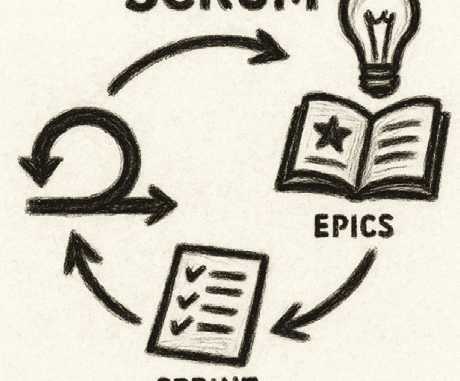
Codzienna praca hurtowni spożywczej opiera się na rutynie: dostawy, zamówienia, magazyn działający jak zegarek. Rutyna daje wysoką efektywność operacyjną, ale nie wystarcza, gdy trzeba wdrożyć system B2B, zautomatyzować magazyn albo wejść na nowy rynek. Artykuł tłumaczy od podstaw metodykę Scrum — czym jest Sprint, Backlog, User Story, Task, Bug i EPIC — na konkretnych przykładach z hurtowni, przetwórni warzyw i masarni. Omawia też rytuały scrumowe (Sprint Planning, Daily, Review, Retrospektywa), role w zespole oraz rolę tablicy w aplikacji Jira.
Scrum in Practice — An Explanation for Beginners
In a typical grocery wholesale business we are dealing with a repeatable logistics cycle: deliveries to shops are carried out every day, the product range is ordered from suppliers, and the warehouse has to work as smoothly as clockwork. Such routine work makes high operational efficiency possible, but it is not conducive to the implementation of larger changes, innovations, or new products and services.
What is Scrum?
When a wholesale business has to develop, change its work structure, introduce new logistics services, implement an order-automation system or enter new markets — routine ceases to be sufficient. Without an appropriate organisation of work, only superficial, simple improvements are possible. Complex projects — such as the implementation of a B2B system, warehouse automation, or a complete change of the delivery model — require well-thought-out project management.
In such situations the Scrum methodology performs excellently — one of the most popular agile project management methods (Agile). Scrum makes it possible to effectively divide large challenges into smaller parts, to carry them out cyclically, and to deliver valuable results even in difficult, long-lasting and complex undertakings.
Sprint
A Sprint is an established period of time (most often 1–2 weeks) in which the team carries out a defined set of tasks.
Example:
Let us assume that a wholesale business wants to launch a new system for the automatic acceptance of orders from shops. Before it buys and implements the system, the team must first analyse the available solutions, check the costs, gather requirements from customers and carry out tests. This entire work cycle can be planned as a Sprint (e.g. a one-week or two-week one). Another Sprint may be the reorganisation of the warehouse with a view to handling new types of goods.
A Sprint begins with planning (Sprint Planning) and ends with a review of the results (Sprint Review) and a discussion (Retrospective).
Backlog
The Product Backlog is a list of all potential tasks, projects or initiatives to be carried out. The Sprint Backlog is the selected tasks which will be carried out in the nearest sprint.
Examples of Backlog-type tasks in a wholesale business:
- Implementation of a B2B system for the placing of orders by shops
- Automation of warehouse stocktaking
- Introduction of new product lines (e.g. organic food)
- Change of the vehicle fleet to more ecological ones
- Employment of a logistics specialist
- Drawing up a plan for entering a new local market
The Backlog is the place where both urgent and forward-looking ideas are written down — from this list the most important ones are chosen and thrown into the Sprint Backlog for the nearest Sprint.
What is a User Story?
A Story is a task or requirement described from the perspective of the user, the customer or the person making use of the product/service. The point is that everyone in the team should understand what something is being done for and for whom.
Story 1: As a customer of a vegetable processing plant I want to have the possibility of ordering fresh vegetables and preserves through the website, so that I do not have to telephone and wait for confirmation of the order.
Story 2: As the owner of a processing plant I want to have every evening a list of orders from shops and restaurants, so as to know how many and what kinds of vegetables and preserves to prepare for the next day.
Story 3: As a customer I want to receive an SMS when my order is ready for collection or dispatch, so as not to waste time on waiting or uncertainty.
A Story is a requirement seen through the eyes of the user. It focuses on the user’s need, not on the technical details of how to do it. It allows the team to understand why a given functionality is needed.
A Story is then divided into concrete, technical tasks, e.g.:
- making the order form,
- connecting up payments,
- preparing the SMS notification system,
- making a panel for managing orders for the processing plant.
In practice, these tasks go onto a list (the Backlog), and at the beginning of the Sprint the team chooses which of them it is able to carry out in the nearest Sprint (e.g. 2 weeks).
Example Story 1: „As a customer I want to order vegetables and preserves over the internet…”, which can be divided into technical Tasks:
- Make the order form on the website.
- Connect up the online payment system.
- Write the backend for handling orders.
- Make the order view for the processing plant.
If the team is fast and the tasks are small, several things can be done in one Sprint. If something cannot be finished within the Sprint — the task passes to the next Sprint.
So then, a Task is a technical job to be carried out. A Bug, on the other hand, is an error to be fixed. For example, in the form for the customer which was made as part of a Task, several errors were found, such as the absence of the data required for an invoice (e.g. the lack of a tax identification number or of the company address). Since these are necessary when issuing an invoice — these deficiencies are regarded as a Bug to be fixed quickly.
What is an EPIC?
An EPIC is a large subject, a business goal or a broad functionality which is too extensive to be carried out in a single Sprint. An EPIC covers a whole group of related needs, often concerning a larger change or implementation in the company. From the perspective of, for example, the owner of a meat-processing plant, an EPIC makes it possible to get to grips with complex undertakings and to divide them into smaller, comprehensible parts — Stories (needs from the point of view of the users).
Example 1:
Implementation of an online ordering system for retail and wholesale customers. This is a broad project, within the framework of which the meat-processing plant launches an online shop so that customers (shops, restaurants, individual consumers) can easily order products.
Possible Stories in this EPIC:
- As a customer I want to order cured meats and meat through the website, so that I do not have to telephone the office.
- As the owner of the meat-processing plant I want to receive every morning a collective list of orders broken down by customers and products, so as to plan production better.
- As a wholesale customer I want to have the possibility of ordering larger quantities at more favourable prices.
- As a customer I want to have the possibility of paying for the order online.
- As a recipient I want to receive a notification when my order is ready for collection or dispatch.
Example 2:
Automation of the process of labelling and tracking product batches. An extensive project aimed at full control over the quality and safety of meat and meat products throughout the entire production cycle.
Possible Stories in this EPIC:
- As a production worker I want to be able to print labels with a QR code for every batch of meat.
- As a quality controller I want to have the possibility of checking the history of a batch on the basis of the code.
- As the owner I want to have access to reports on the use-by dates of products.
- As a customer I want to be able to check the origin of a product by scanning the code.
Example 3:
Modernisation of the warehouse and delivery management system. A broad project covering the improvement of the logistics of the meat-processing plant/abattoir, the limitation of losses and the automation of the handling of deliveries and of the warehouse.
Possible Stories in this EPIC:
- As a warehouseman I want to have access to an electronic list of goods received and issued.
- As a driver I want to receive notifications about routes and delivery schedules.
- As the owner I want to analyse stock levels and the rotation of the product range.
- As a customer I want to receive information about the estimated delivery time of my order.
How does one work with EPICs?
An EPIC is written down in the backlog as a large subject to be carried out. The Product Owner (or the owner of the company) breaks the EPIC down into smaller Stories. Each Story can be divided into still smaller Tasks, that is, technical steps to be carried out. The team chooses which Stories (and their Tasks) to carry out in the nearest sprint.
Board
As can be seen, the division into Epics, Stories, Tasks and backlogs may seem a little complicated. That is why boards were devised, on which all these elements can be found in business practice. Such a complex organisation of the realisation of undertakings is managed by means of the Jira application1. The most important element of this application is the board, on which there are Tasks assigned to the members of the team.
Scrum rituals (ceremonies)
Sprint Planning – planning the sprint
This is a meeting at the beginning of every Sprint (e.g. a 2-week one), during which the team of the production plant jointly establishes which tasks will be carried out in the coming days. The team plans the implementation of a new system of orders from shops and restaurants. In the Sprint Planning they choose the concrete tasks for this Sprint. Every member of the team knows what they will be working on and what the priorities are for the next two weeks.
Daily Scrum (Stand-up) – a short daily meeting
Every day the team meets for 10–15 minutes, most often remotely.
In the plant a programmer says: „Today I will finish the payment integration, but I am waiting for data from the accounting department.”
A tester: „I am finishing checking the correctness of the order form. I still need a test account from IT.”
The manager: „I will check whether all the requirements from the shops have already been gathered.”
Thanks to this everyone knows who is working on what, and potential problems come to light immediately.
Sprint Review – summing up the sprint
At the end of the Sprint the team presents the results of its work (e.g. before the owner, the head of sales or other departments).
They show the working online order form, the payment integration and a report from the tests of the SMS notifications. They discuss what it has been possible to carry out and what requires completion in the next Sprint.
Retrospective – a conversation about what went well and what to improve
After each Sprint the team meets in a calm atmosphere and talks about how the cooperation went, what worked and what could be done better.
The members of the team say: „Cooperation with IT worked well, because we quickly got access to test accounts, but next time it would be better to establish the deadline for receiving data from accounting at the beginning of the Sprint.”
Together they establish how to improve the work in the next Sprint.
Roles in Scrum
- Product Owner – manages the backlog, sets priorities, endeavours to understand what the customer wants.
- Scrum Master – makes sure that the team works in accordance with Scrum, helps to remove obstacles.
- Development Team – the team of developers (programmers, testers, analysts, etc.) who carry out the tasks.
The Product Owner establishes what is most important in the backlog. At the Sprint Planning the team chooses what it is able to do in the next Sprint. During the Sprint the team works on the tasks – progress is visible on the board (e.g. in Jira). The daily Daily is a rapid exchange of information. At the end of the Sprint the team shows the results, discusses what went well and what to improve (Review, Retro). And so on cyclically.
Summary
Routine, repeatable work – such as everyday production, distribution or the handling of orders – has a completely different character from undertakings connected with creating something new. Routine is based on well-worn patterns, experience, clearly defined procedures and tried-and-tested paths of action. Thanks to this it mainly requires effective organisation, discipline and the optimisation of repeatable activities.
Meanwhile the process of creating, of implementing innovations or of introducing changes is incomparably more difficult. It is characterised by great uncertainty, by frequent difficulties which it is impossible to foresee at the start, and by the necessity of treading out new paths without any guarantee of success. Very often the team faces challenges with which it has had no practical contact up to now – there are no ready-made solutions, and every step requires learning as one goes along.
In addition, the process of creating new things meets with resistance or reluctance – on the part of co-workers, customers or the whole organisation. This requires not only energy and determination, but also support in the form of clear organisational frameworks.
That is precisely why, in creative and developmental activities, a disciplined, transparent form of work is indispensable – such as Scrum. Thanks to it the project does not „go out”, does not dissolve into chaos, and individual persons cannot consciously or unconsciously sabotage it. Scrum and similar methodologies ensure structure, transparency and continuity of action, helping the team to consistently carry out even the most demanding undertakings.
1 Jira is a program for managing SCRUM. Producer: Atlassian. First version: 2002. Number of users: according to official Atlassian data (2024), more than 120,000 companies all over the world use Jira (including hundreds of thousands of teams and millions of users).
Wojciech Moszczyński — graduate of the Department of Econometrics and Statistics of Nicolaus Copernicus University in Toruń; specialist in econometrics, finance, data science, and management accounting. He specializes in the optimization of production and logistics processes. He conducts research in the area of the development and application of artificial intelligence. For years he has been engaged in the popularization of machine learning and data science in business environments.