
March 2022 | Przegląd Piekarski i Cukierniczy (Baking and Confectionery Review)
Creating websites by means of the WordPress application
The time of the pandemic caused an acceleration of society’s digitisation process. The internet sphere, because of remote work, lockdowns and quarantine, pushed most of us into the digital world. A kind of parallel world came into being on the internet. It turned out that one could do one’s shopping there, check the TV schedule, find entertainment and education, conduct religious practices and business. Everything fits there. In addition, the importance of mobile devices grew, especially navigation and messaging apps.
One has to be there and have something to show. And again the same stress which accompanies us with every change. One has to find a company which will do it for us, pay, chase it up, one has to see to it. One has to do it not in order to be better, but in order not to be worse. This can really be frustrating. We would like to do our own thing, meanwhile the changes force further challenges upon us and the troubles that go with them. And the reward for this is „not being worse”.
The world has recently accelerated a great deal in the area of building websites. Most people have in their memory stereotypes which are long out of date. Let us therefore recall how it used to be.
Tales of old content
Once, at the beginning of the 21st century, building a website oneself was quite a challenge. At that time static sites reigned — a kind of business card that was displayed on the internet. To this day most churches in Poland have static websites. They have the form of a notice board; sometimes something moves and something can be downloaded. The general composition and functionality give away the time these sites were created.
In the past only a few entities could afford to have dynamic websites. The ability to build them was connected with a knowledge of complicated programming languages and combining them with relational databases.
W-MOSZCZYNSKI ppic 3-22The cost of building an internet shop was comparable to building a real building in the physical world. Only the richest could afford such solutions. Maintaining a website was connected with costs. Most often the maintenance and updating of sites was entrusted to specialised companies. This solution was quite burdensome and impractical, and that is why companies created special editors thanks to which customers could update their own websites themselves.
Deceiving the algorithms
A fairly popular service in those days was site positioning — that is, measures which caused our site to appear at the top of the results page in a Google search. This rivalry continues to this day. The shop which is first wins, has greater sales, greater popularity. In the old days, positioning sites consisted in deceiving Google’s then-imperfect algorithms. Specialised positioning firms set up hundreds of fictitious websites. These sites had appropriate meta-information — that is, information directed straight at the servers — and mutually linked one another through hyperlinks. In order to boost a site to a high level, it was enough to direct the hyperlinks of this specific swarm of artificial sites to that one chosen site.
There were very many methods of deceiving Google’s algorithms. The positioning process was unstable, because the methods of gaining popularity were dishonest. If cooperation with a positioning firm ended, the site fell drastically from its position in the ranking. Positioners placed invisible links on their clients’ positioned sites in order to position further sites, which was also a very common, dishonest practice. It was not interesting sites that won in the ranking, but sites which someone had artificially positioned. The result of this was a deterioration in the quality of search.
In those days there was a kind of technological arms race between the search engine and the positioners. An end to this strange war was put by the development of advanced artificial intelligence algorithms, which began to distinguish real interest in a site from an imitation of interest.
Thanks to this, the stream of money for positioning slowly began to be directed towards Google advertisements. Today, browsing Google search results, at the top we usually have addresses which begin with the word „advertisement”.
Simplification appeared
I would not want this article to look like a promotion of a website-building application. The truth, however, is that nowadays in the world, websites are most often built in the WordPress program. This program was the first to popularise site creation among ordinary users. It caused a flourishing of quality and variety. WordPress has also acquired competitors. Among them one may mention Wix, Zyro, Webwave, Squarespace, Weebly and many, many others.
These editors compete fiercely with one another. The main area of rivalry is the ease of use of these applications. Most of these tools are free of charge; there is no need to install them, because they are used online. Operation is intuitive and requires the skill needed to operate a mobile phone.
How does one set up a site?
The first step in setting up a website is buying a domain. It is enough to type the word „domain” into a search engine for the addresses of companies mediating in their sale to appear.
Prices between individual shops may differ considerably. It should be noted that there are two prices: the price for the first year and for subsequent years. These prices may differ from one another considerably.
[An example price comparison for the domain „mojchleb” („my-bread”) across several extensions from the OVHcloud domain shop shows first-year prices ranging from a few złoty up to around 30 zł, with renewal prices considerably higher — a pattern typical of the domain-registration market.]
The next step is choosing a place for hosting the site. Hosting is simply a place on a virtual disk where the site is published. Of course we can create and make a site available on our own computer. Such a computer would always have to be switched on; every time the computer was switched off it would mean switching off the site, and the famous 404 error* for people visiting it. Besides this, the site would run very slowly. Hosting costs about 100 zł a year and is the best solution. It is best to buy the domain and hosting from one company. Prices in shops offering these services can differ drastically. Less popular companies are usually considerably cheaper; it happens that hosting is free there.
Designing the site
After buying the domain and the hosting, one should contact the company’s helpline. There we will learn how to open the site builder. Every hosting service has special software for handling the site, and from experience I know that it is inefficient to work out by oneself how to navigate this program. At this stage one should already know in which editor we will be building our site. I recommend the WordPress program, because it has the most plugins and templates, elements which I will discuss in a moment. It is also not without significance that this program has the most Polish-language tutorials on YouTube.
Plugins
The plugins I just mentioned are additional improvements to the program. We open the WordPress editor online. It is very intuitive and simple. However, we may want something more, e.g. an additional calendar, an editor for links to social media, or better monitoring of visits to our site. We can install similar applications on our phones. We have a factory-installed step-counting app, but we want something more, and we install an app that measures time and calories burned. We install plugins directly from within the WordPress editor. When choosing, one should pay attention to whether the application is still supported by the producer. Usually, after installing a plugin, some new buttons appear which have to be found in the editor. We do not choose plugins ourselves, but make use of other users’ opinions from the network. To begin with it is worth typing into Google: the best plugins for WordPress, in order to find out what is currently popular.
[A typical ranking of WordPress plugins from an English-language guide lists categories such as analytics, form builders, landing-page builders, SEO tools, email delivery, lead generation, giveaways, membership management, social feeds, automation, browser notifications, and social-proof apps.]
Templates
There are hundreds of WordPress templates on the internet; it is enough to type into Google: wordpress templates 2021 bakery, in order to receive hundreds of templates for bakeries and confectioners’ shops. Most templates can be downloaded free of charge. Really good templates are paid for; their cost usually does not exceed 300 zł.
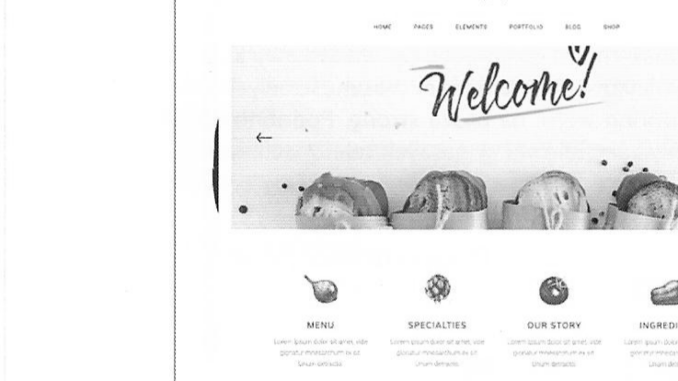
[Example: the „Morsel” bakery-themed WordPress template.]
One can design one’s site on a free template, and then with one click of the mouse replace it with another template. Adapting a template consists in changing the wording, introducing one’s own elements, photos and graphics in place of the existing ones. On the market one can find many companies which build websites in WordPress. However, it is best to build the site oneself, because in the future we will have influence over it, we will be able to expand it ourselves, enriching it with various elements such as, for example, the baker’s own blog, customer forums, good advice and recipes, or even one’s own online shop.
Building a site in WordPress is as simple as using an app on a phone. With time, expanding one’s own site can become a kind of useful hobby. That is why it is worth getting involved in this process from the beginning.
A couple of words about positioning
As I mentioned, nowadays Google’s algorithms can no longer be deceived so easily. What counts is an honest message, attractiveness and aesthetics.
At present it seems that, alongside the number of visits, the most important factor influencing a site’s position is also the number of times the site is bookmarked by customers. If a bakery or confectioner’s shop operates locally, the most important thing is for it to gain popularity among the local residents. The best way to do this is to place the bakery’s and shops’ business card as a listing on Google Maps. The address of the bakery’s website must be attached to it. The site should be interesting and refer strongly to the local environment. One must first consider what one would oneself like to find on such a site. Certainly the most important thing is the shops’ opening hours. What else might interest me? Some history of the place, which we know perfectly well, some local recipe, a nice column, or a video from a recently celebrated harvest festival.
Creativity and passion are becoming key elements of success. It is not worth standing aside and repeating that changes do not concern us. It is worth making use of the solutions which the digital revolution brings us.
Wojciech Moszczyński
* https://www.moj-startup.pl/kreator-stron-www/
Wojciech Moszczyński — graduate of the Department of Econometrics and Statistics of Nicolaus Copernicus University in Toruń; specialist in econometrics, finance, data science, and management accounting. He specializes in the optimization of production and logistics processes. He conducts research in the area of the development and application of artificial intelligence. For years he has been engaged in the popularization of machine learning and data science in business environments.
Dodaj komentarz