
February 2023 | Przegląd Piekarski i Cukierniczy (Baking and Confectionery Review)
The Agile method in a bakery
Hard times are coming; we will undoubtedly experience difficulties which we last encountered several decades ago. Inflation, difficulties in obtaining external financing, or interrupted supply chains are only some of the problems. Most of them are macroeconomic phenomena, and so affect all industries. It would seem that the baking industry is in a fairly stable position compared with other, more threatened industries. This does not have to be the case at all. The situation may change in a dynamic and unpredictable way. Of course everyone eats bread, but changes which may threaten our industry may appear in areas which we are currently unable to predict. What good is it that everyone eats bread every day, if over a perspective of a dozen or so months a large part of the local residents may leave in search of work, or for other reasons? How can one keep paying off expensive machines when it is possible to lose a large part of one’s income? After all, at the same time there may appear further drastic increases in energy prices combined with interruptions in its supplies.
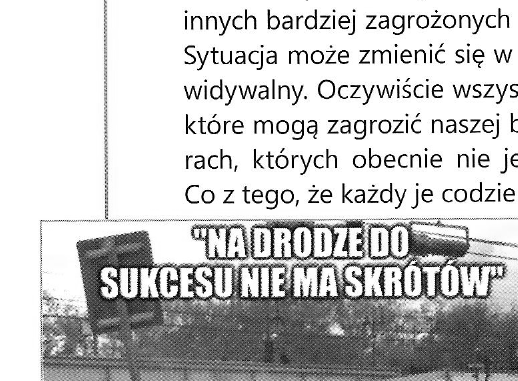
[Illustration caption: „THIS IS WHAT HAPPENS WHEN… YOU DON’T KNOW THE AGILE METHOD”]
Instead of assuming apocalyptic scenarios, it is undoubtedly worth thinking with a bit of optimism about how to make use of the crisis. To come out of it stronger and more efficient than others.
A plan for wartime
It is reasonable to adopt some plan before every crisis. It could be plan A, then B, and even C. It’s just that one does not know whether all three plans won’t lead us astray.
Experienced strategists say that a plan drawn up in case of war, a plan for a weeks-long war strategy, is relatively up to date only on the first day of the war. After that it can be thrown in the bin.
W-MOSZCZYNSKI ppic 2-23It is difficult to plan one’s actions in detail when it is impossible to predict what will happen. We have seen how much the pandemic changed in our lives; now war, in a moment recession will arrive, a possible change of government, a further wave of emigration from Ukraine, or perhaps an exodus of our own citizens in search of work and a better life. Nobody even tries to speculate what the next scene in this spectacle will be.
So it is not worth planning, but rather having one’s eyes wide open and waiting for the course of events.
And what if we have already started building something? We have costs and topics already begun. Why should we wait? Maybe it’s worth undertaking some initiative? Only how does one plan it? It is worth getting to know Agile approaches!
Agile for hard times
The Agile method of running projects is a way of realising plans which allows extremely fast adaptation to changing conditions. It is something which fits perfectly with today’s uncertain times. This method finds application in all industries. Together with civilisational development, external conditions are becoming more and more complicated; more and more surprising plot twists and social phenomena appear, of which we would not even have thought a year ago. It should also be added that with the appearance of great worldwide catastrophes, such as the pandemic, or the first great kinetic war in Europe in 80 years, changes which had appeared in an evolutionary way suddenly took on a revolutionary form. This in turn forces us, entrepreneurs, to change our way of thinking.
The Agile method of realising projects came into being in the software producers’ industry. Writing software was once something new. It was not known how to manage this process. So attempts were made to use a method which intuitively fitted the process of building IT applications very well. The project management method of the construction industry was chosen, the so-called Waterfall method.
Both in building houses and in building computer programs, requirements were initially gathered from clients. Similarly, a realisation plan was created, planning the successive stages of work. This was done by means of a Gantt chart. On this chart, every stage of work contains a detailed plan for the involvement of specific specialists and the appropriate material resources.
So, similarly to building a house, when building software, the requirements and expectations of investors were gathered, the application was designed with all its functionalities and scope of operation. Applications were built in a similar way to how bridges or houses are designed. A bridge is a structure which, before work begins, must be designed from beginning to end. All the details, installations and technical devices have to be described in the plan. All activities have to be carried out in a strictly defined order. Every element has to fit to the millimetre.
The Gantt chart resembles a waterfall, hence the name of the method — Waterfall.
[A Gantt chart showing a project’s tasks laid out across a calendar of days, each bar spanning its planned duration from start to finish — the classic cascading „waterfall” visual the method is named after.]
Why doesn’t the Waterfall method always work?
One can sometimes come across buildings in which something does not fit with something else. The handrails are too big, or the doors do not open because of too great a slope of the ceiling. Are these errors resulting from bad design? Sometimes building crews depart from the design assumptions because the planned elements, e.g. handrails, could not be delivered, and waiting for another supplier would significantly delay the realisation of the building. It happens that large fragments of the façade or specialist construction elements, such as, for example, ventilation shafts, are changed ad hoc, because strictly sticking to the design threatens the deadlines for the whole investment’s realisation. So some elements are sometimes replaced by their substitutes. In construction, the situations described here happen very rarely and sometimes lead to technical complications. These events are certainly an error in the project’s realisation.
Writing software is also building something, building an application in accordance with a defined design. However, it happens that applying the Waterfall method can lead to disaster.
A bridge-building plan gone off the rails
It is best to compare this to building a bridge. Everything has been perfectly planned from beginning to end. Construction of the bridge has begun. Suddenly, after 3 months of work, it turns out that a new material has appeared — plastic, which can successfully replace steel. Thanks to this the bridge’s construction time can be cut by half, and the costs by as much as 30%. A moment after receiving this information, while we still can’t collect our thoughts, the main investor appears, who declares that he wants a wider bridge, so that an additional railway track fits on it — for which he will of course gladly pay.
Such a mosaic of events could drive the bridge project’s manager to the brink of a nervous breakdown. It is hard to imagine such a situation in the construction industry. I assure you, however, that the example described here is typical for the IT industry.
What is Agile?
In English, „agile” means nimble or manoeuvrable — that is, capable of dodging and turning. This is a very good name for this method. Writing an application often takes a dozen or so months. During this time the technology often changes, the libraries and tooling environments change. Usually the client, in the course of the project, repeatedly changes their expectations regarding the functionality and final applications of the app. It should, however, be remembered that we do not have to agree to all changes.
To show briefly what the Agile method consists of, we will use a simple example. Since we live in a front-line-adjacent country, we can make use of a comparison to military missiles.
Let us assume that the Waterfall method is an ordinary unguided rocket. Before we launch the rocket, we have to determine the target of the attack. We calculate the flight trajectory and enter the appropriate corrections connected with wind strength and air humidity. After the rocket is launched, we can no longer do anything. If the attack target moves by a few metres, the rocket will not hit it. If anti-aircraft defence missiles appear, the rocket will be shot down, because it is not capable of changing its flight trajectory. One can decide only at the beginning; nothing can be changed any more during the missile’s flight.
Now it’s time for Agile; in our example this is a self-guided missile. The operator sets its target before launching the rocket. After launch, the rocket begins to manoeuvre, evading enemy anti-aircraft defence. Sometimes it flies in a completely different direction from the indicated target, then returns to the correct course. The operator sees the enemy target the whole time, in the direction our clever missile is flying. It may turn out that during the missile’s flight, the operator sees another, more attractive target, and directs the flying rocket there instead.
The Agile method of realising projects is the basic assumption of flexible, modern project realisation in a critically changing economic-technological environment. Agile is perceived as a philosophy, a kind of attitude towards mounting difficulties. This philosophy is realised through the application of the so-called Scrum method, which to this day is the most popular Agile working method in IT.
Substantive consultation: Klaudia Purchała-Przybyła, Line Manager, Unity Group
Wojciech Moszczyński
Wojciech Moszczyński — an expert in the field of mathematical optimisation and predictive modelling. For years engaged in popularising econometric methods in business environments. He specialises in optimising sales, production and logistics processes. For 15 years he worked as a financial expert specialising in the area of controlling and management accounting. For 10 years he has worked as a data analyst (data scientist). A graduate of the Department of Econometrics and Statistics of Nicolaus Copernicus University in Toruń. Currently employed as Senior Data Scientist at the Polish company Unity Group.
Dodaj komentarz