
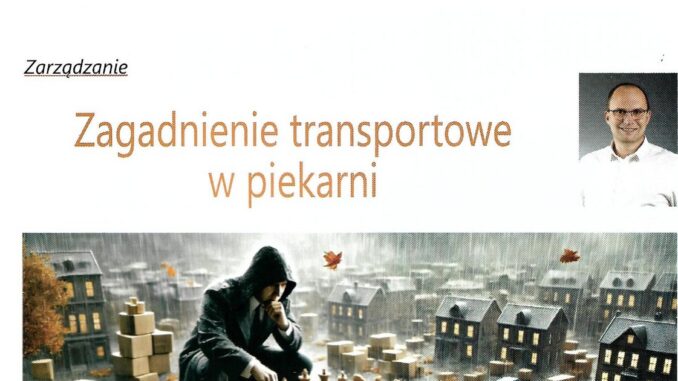
For a bakery owner with a dozen or so vehicles, planning routes efficiently is not easy. It is a logistical challenge that must be handled every day in order to deliver fresh bread to dozens of locations in the city and surrounding area. Each vehicle usually has an assigned route, and the whole operation must work like a well-oiled machine. In practice, however, managing such deliveries resembles a game of chess.
A game of chess can be won or lost. If we win at transportation chess, no one notices. If we lose, some shop will have no bread. There will be penalties, complaints and justified criticism of an unreliable supplier. I have already written about the transportation problem, among other places, in Przegląd Zbożowo-Młynarski (2021, no. 4, “The Transportation Problem—Optimizing Flour Deliveries to Bakeries Using an Operations-Research Algorithm”).
W-MOSZCZYNSKI-2024-12-51Why is route planning a game of chess?
Vehicles on the first shift usually have prescribed routes that they travel every day, delivering bread to particular locations. This provides a degree of routine, but does not eliminate difficulties. If one vehicle breaks down and the driver of another falls ill, trouble begins immediately. The owner must react quickly to organize a replacement and avoid interruptions in deliveries.
Road works, temporary closures of viaducts or bridges and morning traffic jams may delay a delivery, preventing fresh bread from reaching customers on time and affecting the quality of service and the bakery’s reputation.
On the second shift, vehicles must replenish bread at locations that have already sold out. This time the routes are different—always more complicated and variable than those on the first shift. There are usually fewer vehicles making second-shift deliveries, and there is also the problem of collecting returns. The bakery owner must continually update the route plan to account for new requirements.
During the second shift, some locations require rapid delivery—for example, a large supermarket where morning customer traffic is heavy. Other places, such as small neighborhood shops, can wait. The owner must determine priorities, complicating the entire process. In addition to delivering goods, the vehicles must collect unsold bread and return it to the bakery. This adds another element to an already complex route puzzle.
Planning difficulties
Route planning is time-consuming and requires great flexibility. The bakery owner must often account for driver absences, changing road conditions, vehicle failures and the constant need to save time and fuel. On Friday, one driver does not come to work, and in addition part of a key route is closed because a railway viaduct has temporarily been taken out of service. Traffic jams form across the city; even at dawn the route is congested because the metropolitan bypass has been closed. Another driver must take over the absent driver’s duties and deliver bread on time while coping with congestion and route changes. It scarcely needs saying that such difficulties can make one’s head spin.
What I have described is not the worst of it. The worst part is that this hopeless task must be solved now, immediately. The drivers are sitting in their vehicles and the shops are waiting for bread deliveries. Act—play chess!
What are the transportation problem and operations research?
The transportation problem is a classic mathematical and logistical task involving the optimum assignment of resources—for example, vehicles—to different tasks, or deliveries, in a manner that minimizes costs such as time and fuel while meeting specified requirements. The algorithm can also maximize delivery time or minimize the risk that an entire delivery plan will collapse because of some mundane error.
The transportation problem is part of operations research—a discipline that uses mathematical methods and algorithms to solve logistical and optimization problems.
For a bakery, this means finding the shortest and most effective route for every delivery while accounting for constraints such as drivers’ working hours, delivery priorities and bread returns. Solving such problems is difficult and time-consuming. It requires many variables to be considered simultaneously, which can be overwhelming.
Why will a bakery owner not create the algorithm independently?
Creating an algorithm to solve the transportation problem is a complex task requiring advanced knowledge of mathematics, programming and logistics. A bakery owner occupied with day-to-day business management has neither the time nor the appropriate tools to develop such an algorithm independently. What is more, it would require road-condition, customer-demand and fleet-status data to be updated continuously. It is unlikely that any team of data-science specialists would undertake to build such an optimization model. Is the problem insoluble?
Ready-made online applications supporting route planning
Fortunately, ready-made solutions exist that use route-optimization algorithms and can make a bakery owner’s life considerably easier. Applications such as MapGO, Routimo and Optifire make it possible to plan delivery routes quickly while accounting for priorities, returns, congestion, failures and other variables. They allow the owner to concentrate on running the bakery instead of spending hours planning routes manually.
How does this work? The application is installed on a telephone or laptop. Sometimes the program operates online, like Google Maps or ChatGPT. These programs are usually integrated with Google Maps and operate like overlays. One need only load a list of delivery locations; the program indicates their order and sends the delivery plan to the driver’s mobile telephone.
What programs are available and how much do they cost per month?
Below are several online applications supporting transportation tasks such as route planning and optimization.
Routimo. A system for managing routes and drivers’ work that automates route planning and monitors a fleet in real time. Its functions include customer communication, a mobile application for drivers and electronic document circulation. Standard plan: PLN 69 net per month per vehicle; Professional plan: PLN 99 net per month per vehicle.
Solvertech—Tasha. Software for planning distribution and transportation, using mathematical route optimization for deliveries and collections. It reduces transportation costs by as much as 20% and integrates with ERP, WMS and TMS systems. The monthly price for using Solvertech’s Tasha application depends on the number of vehicles and dispatch workstations. Fees are charged under a subscription model (SaaS). To obtain an exact quotation tailored to the characteristics of a fleet, the manufacturer’s website calculator should be used.
PTV OptiFlow. Cloud-based route-optimization software that eliminates the need for additional server infrastructure. It enables orders, vehicles and plans to be scaled and handles up to 10,000 orders within a single plan. Prices are set individually depending on the customer’s specific requirements, such as the number of vehicles in the fleet, the range of functions and additional requirements.
Zeo Route Planner. An application for route planning and optimization that helps companies plan the shortest, fastest and most effective routes. It supports routes with one or multiple drivers and integrates with navigation applications. The monthly plan costs USD 35 per seat, USD 32 per seat with quarterly payment, or USD 29 per seat with annual payment. For fleets, importantly, the fee is charged per seat rather than per driver. Drivers can therefore be assigned to and changed for a given seat without additional costs.
Optifire. A free route-planning and optimization application that enables routes to be determined in only five minutes. It helps reduce planning time and transportation costs and organize the flow of information. Optifire offers different pricing plans. According to available information, prices begin at PLN 69 per month.
Selecting the right application depends on a company’s specific needs, such as fleet size, number of orders and required additional functions. It is worth testing several applications to find the solution best suited to the organization’s particular way of working. Most applications have a free trial period during which they can be tested in action.
Wojciech Moszczyński
Wojciech Moszczyński—graduate of the Department of Econometrics and Statistics of Nicolaus Copernicus University in Toruń; specialist in econometrics, finance, data science and management accounting. He specializes in optimizing production and logistics processes. He conducts research into the development and application of artificial intelligence. For years, he has been engaged in popularizing machine learning and data science in business environments.
Dodaj komentarz